


Page 64 - Demo
P. 64
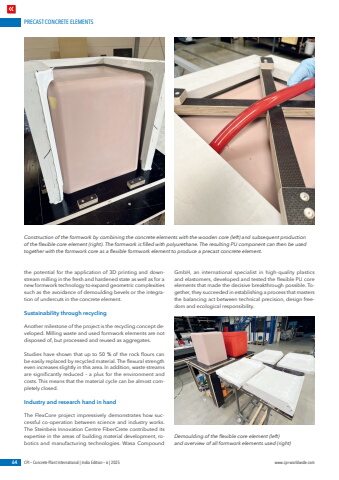
PRECAST CONCRETE ELEMENTS64 CPI %u2013 Concrete Plant International | India Edition %u2013 6 | 2025 www.cpi-worldwide.comthe potential for the application of 3D printing and downstream milling in the fresh and hardened state as well as for a new formwork technology to expand geometric complexities such as the avoidance of demoulding bevels or the integration of undercuts in the concrete element.Sustainability through recyclingAnother milestone of the project is the recycling concept developed. Milling waste and used formwork elements are not disposed of, but processed and reused as aggregates.Studies have shown that up to 50 % of the rock flours can be easily replaced by recycled material. The flexural strength even increases slightly in this area. In addition, waste streams are significantly reduced %u2013 a plus for the environment and costs. This means that the material cycle can be almost completely closed.Industry and research hand in handThe FlexCore project impressively demonstrates how successful co-operation between science and industry works. The Steinbeis Innovation Centre FiberCrete contributed its expertise in the areas of building material development, robotics and manufacturing technologies. Wasa Compound GmbH, an international specialist in high-quality plastics and elastomers, developed and tested the flexible PU core elements that made the decisive breakthrough possible. Together, they succeeded in establishing a process that masters the balancing act between technical precision, design freedom and ecological responsibility.Construction of the formwork by combining the concrete elements with the wooden core (left) and subsequent production of the flexible core element (right). The formwork is filled with polyurethane. The resulting PU component can then be used together with the formwork core as a flexible formwork element to produce a precast concrete element. Demoulding of the flexible core element (left) and overview of all formwork elements used (right)


