


Page 190 - Demo
P. 190
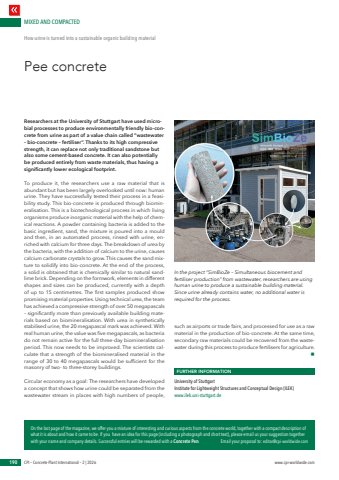
MIXED AND COMPACTEDCPI %u2013 Concrete Plant International %u2013 2 | 2026 www.cpi-worldwide.comOn the last page of the magazine, we offer you a mixture of interesting and curious aspects from the concrete world, together with a compact description of what it is about and how it came to be. If you have an idea for this page (including a photograph and short text), please email us your suggestion together with your name and company details. Successful entries will be rewarded with a Concrete Pen. Email your proposal to: editor@cpi-worldwide.com190Pee concreteHow urine is turned into a sustainable organic building materialResearchers at the University of Stuttgart have used microbial processes to produce environmentally friendly bio-concrete from urine as part of a value chain called %u201cwastewater %u2013 bio-concrete %u2013 fertiliser%u201d. Thanks to its high compressive strength, it can replace not only traditional sandstone but also some cement-based concrete. It can also potentially be produced entirely from waste materials, thus having a significantly lower ecological footprint.To produce it, the researchers use a raw material that is abundant but has been largely overlooked until no human urine. They have successfully tested their process in a feasibility study. This bio-concrete is produced through biomineralisation. This is a biotechnological process in which living organisms produce inorganic material with the help of chemical reactions. A powder containing bacteria is added to the basic ingredient, sand, the mixture is poured into a mould and then, in an automated process, rinsed with urine, enriched with calcium for three days. The breakdown of urea by the bacteria, with the addition of calcium to the urine, causes calcium carbonate crystals to grow. This causes the sand mixture to solidify into bio-concrete. At the end of the process, a solid is obtained that is chemically similar to natural sandlime brick. Depending on the formwork, elements in different shapes and sizes can be produced, currently with a depth of up to 15 centimetres. The first samples produced show promising material properties. Using technical urea, the team has achieved a compressive strength of over 50 megapascals %u2013 significantly more than previously available building materials based on biomineralisation. With urea in synthetically stabilised urine, the 20 megapascal mark was achieved. With real human urine, the value was five megapascals, as bacteria do not remain active for the full three-day biomineralisation period. This now needs to be improved. The scientists calculate that a strength of the biomineralised material in the range of 30 to 40 megapascals would be sufficient for the masonry of two- to three-storey buildings.Circular economy as a goal: The researchers have developed a concept that shows how urine could be separated from the wastewater stream in places with high numbers of people, such as airports or trade fairs, and processed for use as a raw material in the production of bio-concrete. At the same time, secondary raw materials could be recovered from the wastewater during this process to produce fertilisers for agriculture.nFURTHER INFORMATIONUniversity of StuttgartInstitute for Lightweight Structures and Conceptual Design (ILEK)www.ilek.uni-stuttgart.deIn the project %u201cSimBioZe %u2013 Simultaneous biocement and fertiliser production%u201d from wastewater, researchers are using human urine to produce a sustainable building material. Since urine already contains water, no additional water is required for the process.


