


Page 18 - Demo
P. 18
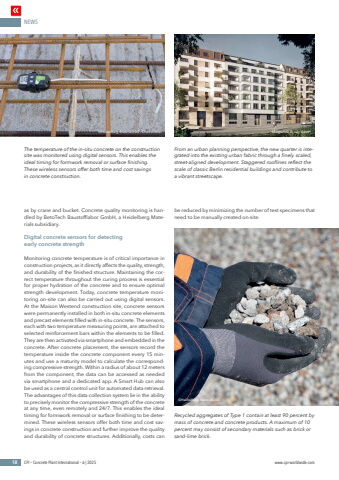
NEWS18 CPI %u2013 Concrete Plant International %u2013 6 | 2025 www.cpi-worldwide.comas by crane and bucket. Concrete quality monitoring is handled by BetoTech Baustofflabor GmbH, a Heidelberg Materials subsidiary.Digital concrete sensors for detecting early concrete strengthMonitoring concrete temperature is of critical importance in construction projects, as it directly affects the quality, strength, and durability of the finished structure. Maintaining the correct temperature throughout the curing process is essential for proper hydration of the concrete and to ensure optimal strength development. Today, concrete temperature monitoring on-site can also be carried out using digital sensors. At the Maison Westend construction site, concrete sensors were permanently installed in both in-situ concrete elements and precast elements filled with in-situ concrete. The sensors, each with two temperature measuring points, are attached to selected reinforcement bars within the elements to be filled. They are then activated via smartphone and embedded in the concrete. After concrete placement, the sensors record the temperature inside the concrete component every 15 minutes and use a maturity model to calculate the corresponding compressive strength. Within a radius of about 12 meters from the component, the data can be accessed as needed via smartphone and a dedicated app. A Smart Hub can also be used as a central control unit for automated data retrieval. The advantages of this data collection system lie in the ability to precisely monitor the compressive strength of the concrete at any time, even remotely and 24/7. This enables the ideal timing for formwork removal or surface finishing to be determined. These wireless sensors offer both time and cost savings in concrete construction and further improve the quality and durability of concrete structures. Additionally, costs can be reduced by minimizing the number of test specimens that need to be manually created on-site.The temperature of the in-situ concrete on the construction site was monitored using digital sensors. This enables the ideal timing for formwork removal or surface finishing. These wireless sensors offer both time and cost savings in concrete construction. From an urban planning perspective, the new quarter is integrated into the existing urban fabric through a finely scaled, street-aligned development. Staggered rooflines reflect the scale of classic Berlin residential buildings and contribute to a vibrant streetscape. Recycled aggregates of Type 1 contain at least 90 percent by mass of concrete and concrete products. A maximum of 10 percent may consist of secondary materials such as brick or sand-lime brick. %u00a9Heidelberg Materials AG I Linus Lintner%u00a9Heidelberg Materials AG%u00a9Lagrande Group GmbH


