


Page 25 - Demo
P. 25
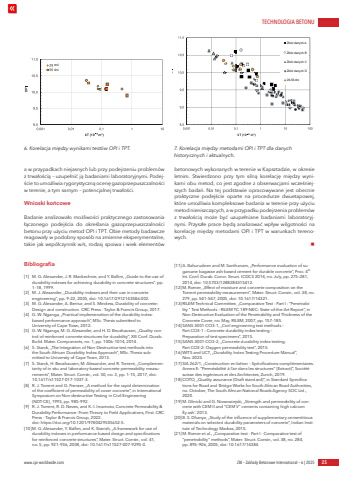
TECHNOLOGIA BETONUwww.cpi-worldwide.com%u0009 ZBI %u2013 Zak%u0142ady Betonowe International %u2013 6 | 2025 25a w przypadkach niejasnych lub przy podejrzeniu problem%u00f3w z trwa%u0142o%u015bci%u0105 %u2013 uzupe%u0142ni%u0107 j%u0105 badaniami laboratoryjnymi. Podej%u015bcie to umo%u017cliwia rygorystyczn%u0105 ocen%u0119 gazoprzepuszczalno%u015bci w terenie, a tym samym %u2013 potencjalnej trwa%u0142o%u015bci.Wnioski ko%u0144coweBadanie analizowa%u0142o mo%u017cliwo%u015bci praktycznego zastosowania %u0142%u0105czonego podej%u015bcia do okre%u015blania gazoprzepuszczalno%u015bci betonu przy u%u017cyciu metod OPI i TPT. Obie metody badawcze reagowa%u0142y w podobny spos%u00f3b na zmienne eksperymentalne, takie jak wsp%u00f3%u0142czynnik w/s, rodzaj spoiwa i wiek element%u00f3w betonowych wykonanych w terenie w Kapsztadzie, w okresie letnim. Stwierdzono przy tym siln%u0105 korelacj%u0119 mi%u0119dzy wynikami obu metod, co jest zgodne z obserwacjami wcze%u015bniejszych bada%u0144. Na tej podstawie opracowywane jest obecnie praktyczne podej%u015bcie oparte na procedurze dwuetapowej, kt%u00f3re umo%u017cliwia kompleksowe badania w terenie przy u%u017cyciu metod nieniszcz%u0105cych, a w przypadku podejrzenia problem%u00f3w z trwa%u0142o%u015bci%u0105 mo%u017ce by%u0107 uzupe%u0142niane badaniami laboratoryjnymi. Przysz%u0142e prace b%u0119d%u0105 analizowa%u0107 wp%u0142yw wilgotno%u015bci na korelacj%u0119 mi%u0119dzy metodami OPI i TPT w warunkach terenowych.nBibliografia[1] M. G. Alexander, J. R. Mackechnie, and Y. Ballim, %u201eGuide to the use of durability indexes for achieving durability in concrete structures%u201d. pp. 1%u201318, 1999.[2] M. J. Alexander, %u201eDurability indexes and their use in concrete engineering%u201d, pp. 9%u201322, 2005, doi: 10.1617/2912143586.002.[3] M. G. Alexander, A. Bentur, and S. Mindess, Durability of concrete: Design and construction. CRC Press - Taylor & Francis Group, 2017.[4] G. W. Nganga, %u201ePractical implemenation of the durability indexbased performance approach%u201d, MSc. Thesis submitted to University of Cape Town, 2012.[5] G. W. Nganga, M. G. Alexander, and H. D. Beushausen, %u201eQuality control of reinforced concrete structures for durability%u201d, XIII Conf. Durab. Build. Mater. Components, no. 1, pp. 1006%u20131014, 2014.[6] S. Starck, %u201eThe Integration of Non-Destructive test methods into the South African Durability Index Approach%u201d, MSc. Thesis submitted to University of Cape Town, 2013.[7] S. Starck, H. Beushausen, M. Alexander, and R. Torrent, %u201eComplementarity of in situ and laboratory-based concrete permeability measurements%u201d, Mater. Struct. Constr., vol. 50, no. 3, pp. 1%u201315, 2017, doi: 10.1617/s11527-017-1037-3.[8] R. J. Torrent and G. Frenzer, %u201eA method for the rapid determination of the coefficient of permeability of cover concrete%u201d, in International Symposium on Non-destructive Testing in Civil Engineering (NDT-CE), 1995, pp. 985%u2013992.[9] R. J. Torrent, R. D. Neves, and K.-I. Imamoto, Concrete Permeability & Durability Performance: From Theory to Field Applications, First. CRC Press - Taylor & Francis Group, 2022. doi: https://doi.org/10.1201/9780429505652-5.[10]M. G. Alexander, Y. Ballim, and K. Stanish, %u201eA framework for use of durability indexes in performance-based design and specifications for reinforced concrete structures%u201d, Mater. Struct. Constr., vol. 41, no. 5, pp. 921%u2013936, 2008, doi: 10.1617/s11527-007-9295-0.[11] A. Bahurudeen and M. Santhanam, %u201ePerformance evaluation of sugarcane bagasse ash-based cement for durable concrete%u201d, Proc. 4thInt. Conf. Durab. Concr. Struct. ICDCS 2014, no. July, pp. 275%u2013281, 2014, doi: 10.5703/1288284315412.[12]M. Romer, %u201eEffect of moisture and concrete composition on the Torrent permeability measurement%u201d, Mater. Struct. Constr., vol. 38, no. 279, pp. 541%u2013547, 2005, doi: 10.1617/14321.[13]RILEM Technical Committee, %u201eComparative Test - Part I : \lity \Non-Destructive Evaluation of the Penetrability and Thickness of the Concrete Cover, no. May, RILEM, 2007, pp. 157%u2013185.[14] SANS 3001-CO3-1, %u201eCivil engineering test methods %u2013 Part CO3-1 : Concrete durability index testing %u2013Preparation of test specimens%u201d, 2015.[15] SANS 3001-CO3-2, %u201eConcrete durability index testing. Part CO3-2: Oxygen permeability test%u201d, 2015.[16]WITS and UCT, %u201eDurability Index Testing Procedure Manual%u201d, Nov. 2023.[17] SIA 262/1, %u201eConstruction en b%u00e9ton %u2013 Sp%u00e9cifications compl%u00e9mentaires. Annex E: %u201cPerm%u00e9abilit%u00e9 %u00e0 l%u2019air dans les structures%u201d (Extract)%u201d, Soci%u00e9t%u00e9 suisse des ing%u00e9nieurs et des Architectes, Zurich, 2019.[18] COTO, %u201eQuality assurance (Draft standard)%u201d, in Standard Specifications for Road and Bridge Works for South African Road Authorities, no. October, The South African National Roads Agency SOC Ltd., 2020.[19]M. Glinicki and G. Nowowiejski, %u201eStrength and permeability of concrete with CEM II and %u201cCEM V%u201d cements containing high calcium fly ash%u2019. 2013.[20]B. S. Dhanya, %u201eStudy of the influence of supplementary cementitious materials on selected durability parameters of concrete%u201d, Indian Institute of Technology Madras, 2015.[21]M. Romer et al., %u201eComparative test - Part I - Comparative test of %u201cpenetrability%u201d methods%u201d, Mater. Struct. Constr., vol. 38, no. 284, pp. 895%u2013906, 2005, doi: 10.1617/14384.dnidniZbi%u00f3r danych AZbi%u00f3r danych BZbi%u00f3r danych CZbi%u00f3r danych D28-56 dni6. Korelacja mi%u0119dzy wynikami test%u00f3w OPI i TPT. 7. Korelacja mi%u0119dzy metodami OPI i TPT dla danych historycznych i aktualnych.


