


Page 15 - Demo
P. 15
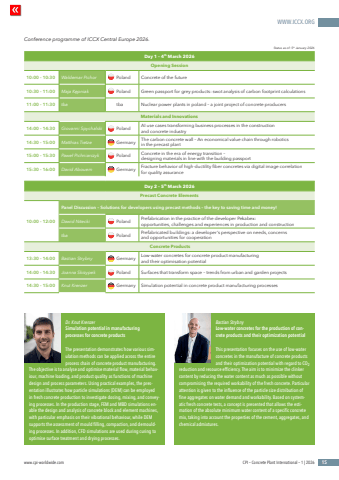
WWW.ICCX.ORGwww.cpi-worldwide.com CPI %u2013 Concrete Plant International %u2013 1 | 2026 15Conference programme of ICCX Central Europe 2026.Status as of: 5th January 2026Dr. Knut KrenzerSimulation potential in manufacturingprocesses for concrete productsThe presentation demonstrates how various simulation methods can be applied across the entire process chain of concrete product manufacturing. The objective is to analyse and optimise material flow, material behaviour, machine loading, and product quality as functions of machine design and process parameters. Using practical examples, the presentation illustrates how particle simulations (DEM) can be employed in fresh concrete production to investigate dosing, mixing, and conveying processes. In the production stage, FEM and MBD simulations enable the design and analysis of concrete block and element machines, with particular emphasis on their vibrational behaviour, while DEM supports the assessment of mould filling, compaction, and demoulding processes. In addition, CFD simulations are used during curing to optimise surface treatment and drying processes.Bastian StrybnyLow-water concretes for the production of concrete products and their optimization potentialThis presentation focuses on the use of low-water concretes in the manufacture of concrete products and their optimization potential with regard to CO2reduction and resource efficiency. The aim is to minimize the clinker content by reducing the water content as much as possible without compromising the required workability of the fresh concrete. Particular attention is given to the influence of the particle size distribution of fine aggregates on water demand and workability. Based on systematic fresh concrete tests, a concept is presented that allows the estimation of the absolute minimum water content of a specific concrete mix, taking into account the properties of the cement, aggregates, and chemical admixtures.Day 1 %u2013 4th March 2026Opening Session10:00 - 10:30 Waldemar Pichor Poland Concrete of the future10:30 - 11:00 Maja K%u0119pniak Poland Green passport for grey products: swot analysis of carbon footprint calculations11:00 - 11:30 tba tba Nuclear power plants in poland %u2013 a joint project of concrete producersMaterials and Innovations14:00 - 14:30 Giovanni Spychalski Poland AI use cases transforming business processes in the construction and concrete industry14:30 - 15:00 Matthias Tietze Germany The carbon concrete wall %u2013 An economical value chain through robotics in the precast plant15:00 - 15:30 Pawe%u0142 Pichniarczyk Poland Concrete in the era of energy transition %u2013 designing materials in line with the building passport15:30 - 16:00 David Abouem Germany Fracture behavior of high-ductility fiber concretes via digital image correlation for quality assuranceDay 2 %u2013 5th March 2026Precast Concrete Elements10:00 - 12:00Panel Discussion %u2013 Solutions for developers using precast methods %u2013 the key to saving time and money!Dawid Nitecki Poland Prefabrication in the practice of the developer Pekabex: opportunities, challenges and experiences in production and constructiontba Poland Prefabricated buildings: a developer%u2018s perspective on needs, concerns and opportunities for cooperation Concrete Products13:30 - 14:00 Bastian Strybny Germany Low-water concretes for concrete product manufacturing and their optimisation potential14:00 - 14:30 Joanna Skrzypek Poland Surfaces that transform space %u2013 trends from urban and garden projects14:30 - 15:00 Knut Krenzer Germany Simulation potential in concrete product manufacturing processes


