


Page 102 - Demo
P. 102
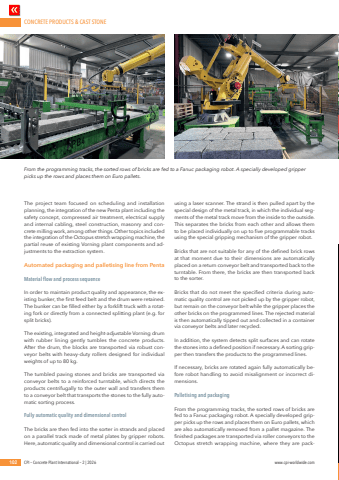
CONCRETE PRODUCTS & CAST STONE102 CPI %u2013 Concrete Plant International %u2013 2 | 2026 www.cpi-worldwide.comThe project team focused on scheduling and installation planning, the integration of the new Penta plant including the safety concept, compressed air treatment, electrical supply and internal cabling, steel construction, masonry and concrete milling work, among other things. Other topics included the integration of the Octopus stretch wrapping machine, the partial reuse of existing Vorning plant components and adjustments to the extraction system.Automated packaging and palletising line from PentaMaterial flow and process sequenceIn order to maintain product quality and appearance, the existing bunker, the first feed belt and the drum were retained. The bunker can be filled either by a forklift truck with a rotating fork or directly from a connected splitting plant (e.g. for split bricks).The existing, integrated and height-adjustable Vorning drum with rubber lining gently tumbles the concrete products. After the drum, the blocks are transported via robust conveyor belts with heavy-duty rollers designed for individual weights of up to 80 kg.The tumbled paving stones and bricks are transported via conveyor belts to a reinforced turntable, which directs the products centrifugally to the outer wall and transfers them to a conveyor belt that transports the stones to the fully automatic sorting process.Fully automatic quality and dimensional controlThe bricks are then fed into the sorter in strands and placed on a parallel track made of metal plates by gripper robots. Here, automatic quality and dimensional control is carried out using a laser scanner. The strand is then pulled apart by the special design of the metal track, in which the individual segments of the metal track move from the inside to the outside. This separates the bricks from each other and allows them to be placed individually on up to five programmable tracks using the special gripping mechanism of the gripper robot.Bricks that are not suitable for any of the defined brick rows at that moment due to their dimensions are automatically placed on a return conveyor belt and transported back to the turntable. From there, the bricks are then transported back to the sorter.Bricks that do not meet the specified criteria during automatic quality control are not picked up by the gripper robot, but remain on the conveyor belt while the gripper places the other bricks on the programmed lines. The rejected material is then automatically tipped out and collected in a container via conveyor belts and later recycled.In addition, the system detects split surfaces and can rotate the stones into a defined position if necessary. A sorting gripper then transfers the products to the programmed lines. If necessary, bricks are rotated again fully automatically before robot handling to avoid misalignment or incorrect dimensions.Palletising and packagingFrom the programming tracks, the sorted rows of bricks are fed to a Fanuc packaging robot. A specially developed gripper picks up the rows and places them on Euro pallets, which are also automatically removed from a pallet magazine. The finished packages are transported via roller conveyors to the Octopus stretch wrapping machine, where they are packFrom the programming tracks, the sorted rows of bricks are fed to a Fanuc packaging robot. A specially developed gripper picks up the rows and places them on Euro pallets.


