


Page 116 - Demo
P. 116
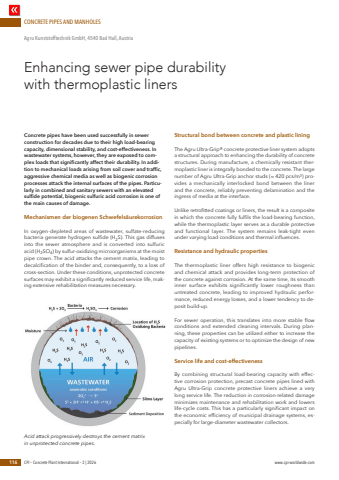
CONCRETE PIPES AND MANHOLES116 CPI %u2013 Concrete Plant International %u2013 2 | 2026 www.cpi-worldwide.comConcrete pipes have been used successfully in sewer construction for decades due to their high load-bearing capacity, dimensional stability, and cost-effectiveness. In wastewater systems, however, they are exposed to complex loads that significantly affect their durability. In addition to mechanical loads arising from soil cover and traffic, aggressive chemical media as well as biogenic corrosion processes attack the internal surfaces of the pipes. Particularly in combined and sanitary sewers with an elevated sulfide potential, biogenic sulfuric acid corrosion is one of the main causes of damage.Mechanismen der biogenen Schwefels%u00e4urekorrosionIn oxygen-depleted areas of wastewater, sulfate-reducing bacteria generate hydrogen sulfide (H2S). This gas diffuses into the sewer atmosphere and is converted into sulfuric acid (H2SO4) by sulfur-oxidizing microorganisms at the moist pipe crown. The acid attacks the cement matrix, leading to decalcification of the binder and, consequently, to a loss of cross-section. Under these conditions, unprotected concrete surfaces may exhibit a significantly reduced service life, making extensive rehabilitation measures necessary.Structural bond between concrete and plastic liningThe Agru Ultra-Grip%u00ae concrete protective liner system adopts a structural approach to enhancing the durability of concrete structures. During manufacture, a chemically resistant thermoplastic liner is integrally bonded to the concrete. The large number of Agru Ultra%u2011Grip anchor studs (%u2248 420 pcs/m%u00b2) provides a mechanically interlocked bond between the liner and the concrete, reliably preventing delamination and the ingress of media at the interface.Unlike retrofitted coatings or liners, the result is a composite in which the concrete fully fulfils the load-bearing function, while the thermoplastic layer serves as a durable protective and functional layer. The system remains leak-tight even under varying load conditions and thermal influences. Resistance and hydraulic propertiesThe thermoplastic liner offers high resistance to biogenic and chemical attack and provides long-term protection of the concrete against corrosion. At the same time, its smooth inner surface exhibits significantly lower roughness than untreated concrete, leading to improved hydraulic performance, reduced energy losses, and a lower tendency to deposit build-up.For sewer operation, this translates into more stable flow conditions and extended cleaning intervals. During planning, these properties can be utilized either to increase the capacity of existing systems or to optimize the design of new pipelines.Service life and cost-effectivenessBy combining structural load-bearing capacity with effective corrosion protection, precast concrete pipes lined with Agru Ultra-Grip concrete protective liners achieve a very long service life. The reduction in corrosion-related damage minimizes maintenance and rehabilitation work and lowers life-cycle costs. This has a particularly significant impact on the economic efficiency of municipal drainage systems, especially for large-diameter wastewater collectors.Enhancing sewer pipe durability with thermoplastic linersAgru Kunststofftechnik GmbH, 4540 Bad Hall, Austria Acid attack progressively destroys the cement matrix in unprotected concrete pipes.


