


Page 72 - Demo
P. 72
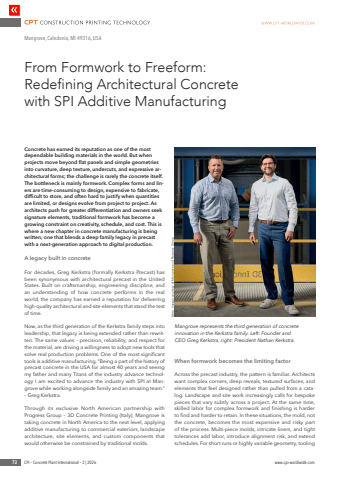
72 CPI %u2013 Concrete Plant International %u2013 2 | 2026 www.cpi-worldwide.comConcrete has earned its reputation as one of the most dependable building materials in the world. But when projects move beyond flat panels and simple geometries into curvature, deep texture, undercuts, and expressive architectural forms; the challenge is rarely the concrete itself. The bottleneck is mainly formwork. Complex forms and liners are time-consuming to design, expensive to fabricate, difficult to store, and often hard to justify when quantities are limited, or designs evolve from project to project. As architects push for greater differentiation and owners seek signature elements, traditional formwork has become a growing constraint on creativity, schedule, and cost. This is where a new chapter in concrete manufacturing is being written; one that blends a deep family legacy in precast with a next-generation approach to digital production.A legacy built in concreteFor decades, Greg Kerkstra (formally Kerkstra Precast) has been synonymous with architectural precast in the United States. Built on craftsmanship, engineering discipline, and an understanding of how concrete performs in the real world, the company has earned a reputation for delivering high-quality architectural and site elements that stand the test of time.Now, as the third generation of the Kerkstra family steps into leadership, that legacy is being extended rather than rewritten. The same values %u2013 precision, reliability, and respect for the material, are driving a willingness to adopt new tools that solve real production problems. One of the most significant tools is additive manufacturing. %u201cBeing a part of the history of precast concrete in the USA for almost 40 years and seeing my father and many Titans of the industry advance technology I am excited to advance the industry with SPI at Mangrove while working alongside family and an amazing team.%u201d %u2013 Greg Kerkstra.Through its exclusive North American partnership with Progress Group %u2013 3D Concrete Printing (Italy), Mangrove is taking concrete in North America to the next level, applying additive manufacturing to commercial exteriors, landscape architecture, site elements, and custom components that would otherwise be constrained by traditional molds.When formwork becomes the limiting factorAcross the precast industry, the pattern is familiar. Architects want complex corners, deep reveals, textured surfaces, and elements that feel designed rather than pulled from a catalog. Landscape and site work increasingly calls for bespoke pieces that vary subtly across a project. At the same time, skilled labor for complex formwork and finishing is harder to find and harder to retain. In these situations, the mold, not the concrete, becomes the most expensive and risky part of the process. Multi-piece molds, intricate liners, and tight tolerances add labor, introduce alignment risk, and extend schedules. For short runs or highly variable geometry, tooling From Formwork to Freeform: Redefining Architectural Concrete with SPI Additive ManufacturingMangrove, Caledonia, MI 49316, USAMangrove represents the third generation of concrete innovation in the Kerkstra family. Left: Founder and CEO Greg Kerkstra, right: President Nathan Kerkstra.Note: Images courtesy of Mangrove and Progress Group


