


Page 74 - Demo
P. 74
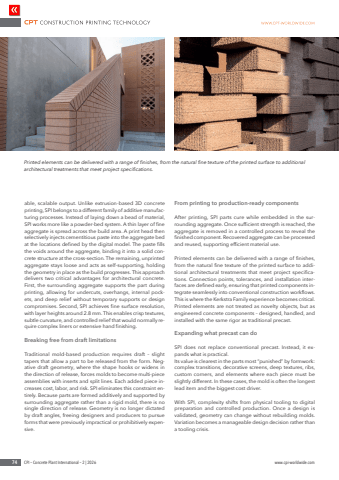
74 CPI %u2013 Concrete Plant International %u2013 2 | 2026 www.cpi-worldwide.comable, scalable output. Unlike extrusion-based 3D concrete printing, SPI belongs to a different family of additive manufacturing processes. Instead of laying down a bead of material, SPI works more like a powder-bed system. A thin layer of fine aggregate is spread across the build area. A print head then selectively injects cementitious paste into the aggregate bed at the locations defined by the digital model. The paste fills the voids around the aggregate, binding it into a solid concrete structure at the cross-section. The remaining, unprinted aggregate stays loose and acts as self-supporting, holding the geometry in place as the build progresses. This approach delivers two critical advantages for architectural concrete. First, the surrounding aggregate supports the part during printing, allowing for undercuts, overhangs, internal pockets, and deep relief without temporary supports or design compromises. Second, SPI achieves fine surface resolution, with layer heights around 2.8 mm. This enables crisp textures, subtle curvature, and controlled relief that would normally require complex liners or extensive hand finishing.Breaking free from draft limitationsTraditional mold-based production requires draft %u2013 slight tapers that allow a part to be released from the form. Negative draft geometry, where the shape hooks or widens in the direction of release, forces molds to become multi-piece assemblies with inserts and split lines. Each added piece increases cost, labor, and risk. SPI eliminates this constraint entirely. Because parts are formed additively and supported by surrounding aggregate rather than a rigid mold, there is no single direction of release. Geometry is no longer dictated by draft angles, freeing designers and producers to pursue forms that were previously impractical or prohibitively expensive.From printing to production-ready componentsAfter printing, SPI parts cure while embedded in the surrounding aggregate. Once sufficient strength is reached, the aggregate is removed in a controlled process to reveal the finished component. Recovered aggregate can be processed and reused, supporting efficient material use.Printed elements can be delivered with a range of finishes, from the natural fine texture of the printed surface to additional architectural treatments that meet project specifications. Connection points, tolerances, and installation interfaces are defined early, ensuring that printed components integrate seamlessly into conventional construction workflows.This is where the Kerkstra Family experience becomes critical. Printed elements are not treated as novelty objects, but as engineered concrete components %u2013 designed, handled, and installed with the same rigor as traditional precast.Expanding what precast can doSPI does not replace conventional precast. Instead, it expands what is practical.Its value is clearest in the parts most %u201cpunished%u201d by formwork: complex transitions, decorative screens, deep textures, ribs, custom corners, and elements where each piece must be slightly different. In these cases, the mold is often the longest lead item and the biggest cost driver.With SPI, complexity shifts from physical tooling to digital preparation and controlled production. Once a design is validated, geometry can change without rebuilding molds. Variation becomes a manageable design decision rather than a tooling crisis.Printed elements can be delivered with a range of finishes, from the natural fine texture of the printed surface to additional architectural treatments that meet project specifications.


