


Page 112 - Demo
P. 112
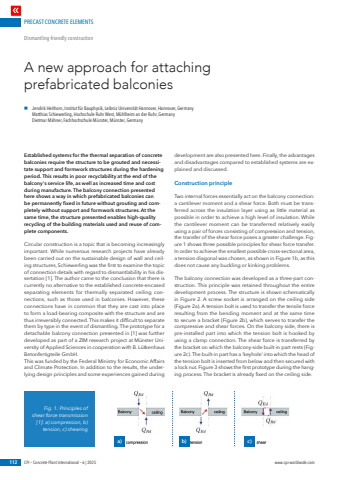
PRECAST CONCRETE ELEMENTS112 CPI %u2013 Concrete Plant International %u2013 6 | 2025 www.cpi-worldwide.comEstablished systems for the thermal separation of concrete balconies require the structure to be grouted and necessitate support and formwork structures during the hardening period. This results in poor recyclability at the end of the balcony's service life, as well as increased time and cost during manufacture. The balcony connection presented here shows a way in which prefabricated balconies can be permanently fixed in future without grouting and completely without support and formwork structures. At the same time, the structure presented enables high-quality recycling of the building materials used and reuse of complete components.Circular construction is a topic that is becoming increasingly important. While numerous research projects have already been carried out on the sustainable design of wall and ceiling structures, Schiewerling was the first to examine the topic of connection details with regard to dismantlability in his dissertation [1]. The author came to the conclusion that there is currently no alternative to the established concrete-encased separating elements for thermally separated ceiling connections, such as those used in balconies. However, these connections have in common that they are cast into place to form a load-bearing composite with the structure and are thus irreversibly connected. This makes it difficult to separate them by type in the event of dismantling. The prototype for a detachable balcony connection presented in [1] was further developed as part of a ZIM research project at M%u00fcnster University of Applied Sciences in cooperation with B. L%u00fctkenhaus Betonfertigteile GmbH. This was funded by the Federal Ministry for Economic Affairs and Climate Protection. In addition to the results, the underlying design principles and some experiences gained during development are also presented here. Finally, the advantages and disadvantages compared to established systems are explained and discussed.Construction principleTwo internal forces essentially act on the balcony connection: a cantilever moment and a shear force. Both must be transferred across the insulation layer using as little material as possible in order to achieve a high level of insulation. While the cantilever moment can be transferred relatively easily using a pair of forces consisting of compression and tension, the transfer of the shear force poses a greater challenge. Figure 1 shows three possible principles for shear force transfer. In order to achieve the smallest possible cross-sectional area, a tension diagonal was chosen, as shown in Figure 1b, as this does not cause any buckling or kinking problems.The balcony connection was developed as a three-part construction. This principle was retained throughout the entire development process. The structure is shown schematically in Figure 2. A screw socket is arranged on the ceiling side (Figure 2a). A tension bolt is used to transfer the tensile force resulting from the bending moment and at the same time to secure a bracket (Figure 2b), which serves to transfer the compressive and shear forces. On the balcony side, there is pre-installed part into which the tension bolt is hooked by using a clamp connection. The shear force is transferred by the bracket on which the balcony-side built-in part rests (Figure 2c). The built-in part has a %u2018keyhole%u2019 into which the head of the tension bolt is inserted from below and then secured with a lock nut. Figure 3 shows the first prototype during the hanging process. The bracket is already fixed on the ceiling side.A new approach for attaching prefabricated balconiesDismantling-friendly constructionn Jendrik Heithorn, Institut f%u00fcr Bauphysik, Leibniz Universit%u00e4t Hannover, Hannover, GermanyMatthias Schiewerling, Hochschule Ruhr West, M%u00fchlheim an der Ruhr, GermanyDietmar M%u00e4hner, Fachhochschule M%u00fcnster, M%u00fcnster, GermanyFig. 1: Principles of shear force transmission [1]: a) compression, b) tension, c) shearing a) b) c)


