


Page 138 - Demo
P. 138
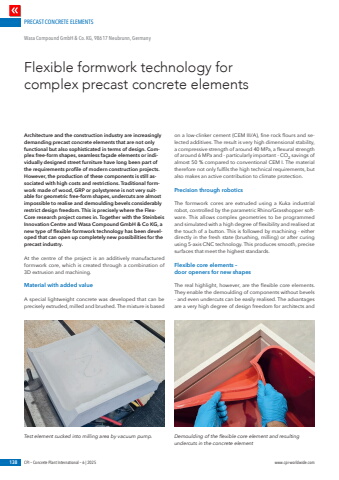
PRECAST CONCRETE ELEMENTS138 CPI %u2013 Concrete Plant International %u2013 6 | 2025 www.cpi-worldwide.comArchitecture and the construction industry are increasingly demanding precast concrete elements that are not only functional but also sophisticated in terms of design. Complex free-form shapes, seamless fa%u00e7ade elements or individually designed street furniture have long been part of the requirements profile of modern construction projects. However, the production of these components is still associated with high costs and restrictions. Traditional formwork made of wood, GRP or polystyrene is not very suitable for geometric free-form shapes, undercuts are almost impossible to realise and demoulding bevels considerably restrict design freedom. This is precisely where the FlexCore research project comes in. Together with the Steinbeis Innovation Centre and Wasa Compound GmbH & Co KG, a new type of flexible formwork technology has been developed that can open up completely new possibilities for the precast industry.At the centre of the project is an additively manufactured formwork core, which is created through a combination of 3D extrusion and machining.Material with added valueA special lightweight concrete was developed that can be precisely extruded, milled and brushed. The mixture is based on a low-clinker cement (CEM III/A), fine rock flours and selected additives. The result is very high dimensional stability, a compressive strength of around 40 MPa, a flexural strength of around 6 MPa and - particularly important - CO2 savings of almost 50 % compared to conventional CEM I. The material therefore not only fulfils the high technical requirements, but also makes an active contribution to climate protection.Precision through roboticsThe formwork cores are extruded using a Kuka industrial robot, controlled by the parametric Rhino/Grasshopper software. This allows complex geometries to be programmed and simulated with a high degree of flexibility and realised at the touch of a button. This is followed by machining - either directly in the fresh state (brushing, milling) or after curing using 5-axis CNC technology. This produces smooth, precise surfaces that meet the highest standards.Flexible core elements %u2013 door openers for new shapesThe real highlight, however, are the flexible core elements. They enable the demoulding of components without bevels - and even undercuts can be easily realised. The advantages are a very high degree of design freedom for architects and Flexible formwork technology for complex precast concrete elementsWasa Compound GmbH & Co. KG, 98617 Neubrunn, GermanyTest element sucked into milling area by vacuum pump. Demoulding of the flexible core element and resulting undercuts in the concrete element


