


Page 19 - Demo
P. 19
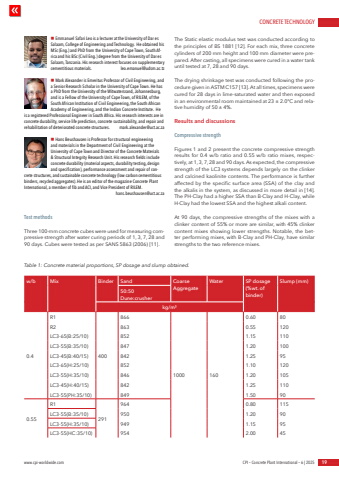
CONCRETE TECHNOLOGYwww.cpi-worldwide.com CPI %u2013 Concrete Plant International %u2013 6 | 2025 19Test methodsThree 100-mm concrete cubes were used for measuring compressive strength after water curing periods of 1, 3, 7, 28 and 90 days. Cubes were tested as per SANS 5863 (2006) [11]. The Static elastic modulus test was conducted according to the principles of BS 1881 [12]. For each mix, three concrete cylinders of 200 mm height and 100 mm diameter were prepared. After casting, all specimens were cured in a water tank until tested at 7, 28 and 90 days. The drying shrinkage test was conducted following the procedure given in ASTM C157 [13]. At all times, specimens were cured for 28 days in lime-saturated water and then exposed in an environmental room maintained at 23 %u00b1 2.0%u00b0C and relative humidity of 50 %u00b1 4%. Results and discussions Compressive strength Figures 1 and 2 present the concrete compressive strength results for 0.4 w/b ratio and 0.55 w/b ratio mixes, respectively, at 1, 3, 7, 28 and 90 days. As expected, the compressive strength of the LC3 systems depends largely on the clinker and calcined kaolinite contents. The performance is further affected by the specific surface area (SSA) of the clay and the alkalis in the system, as discussed in more detail in [14]. The PH-Clay had a higher SSA than B-Clay and H-Clay, while H-Clay had the lowest SSA and the highest alkali content.At 90 days, the compressive strengths of the mixes with a clinker content of 55% or more are similar, with 45% clinker content mixes showing lower strengths. Notable, the better performing mixes, with B-Clay and PH-Clay, have similar strengths to the two reference mixes. n Emmanuel Safari Leo is a lecturer at the University of Dar es Salaam, College of Engineering and Technology. He obtained his MSc (Eng.) and PhD from the University of Cape Town, South Africa and his BSc (Civil Eng.) degree from the University of Dar es Salaam, Tanzania. His research interest focuses on supplementary cementitious materials. leo.emanuel@udsm.ac.tz n Mark Alexander is Emeritus Professor of Civil Engineering, and a Senior Research Scholar in the University of Cape Town. He has a PhD from the University of the Witwatersrand, Johannesburg, and is a Fellow of the University of Cape Town, of RILEM, of the South African Institution of Civil Engineering, the South African Academy of Engineering, and the Indian Concrete Institute. He is a registered Professional Engineer in South Africa. His research interests are in concrete durability, service life prediction, concrete sustainability, and repair and rehabilitation of deteriorated concrete structures. mark.alexander@uct.ac.zan Hans Beushausen is Professor for structural engineering and materials in the Department of Civil Engineering at the University of Cape Town and Director of the Concrete Materials & Structural Integrity Research Unit. His research fields include concrete durability (material aspects, durability testing, design and specification), performance assessment and repair of concrete structures, and sustainable concrete technology (low carbon cementitious binders, recycled aggregates). He is an editor of the magazine Concrete Plant International, a member of fib and ACI, and Vice President of RILEM.hans.beushausen@uct.ac.zaTable 1: Concrete material proportions, SP dosage and slump obtained.w/b Mix Binder Sand Coarse AggregateWater SP dosage(%wt. of binder)Slump (mm)50:50Dune:crusherkg/m%u00b30.4R14008661000 1600.60 80R2 863 0.55 120LC3-65(B:25/10) 852 1.15 110LC3-55(B:35/10) 847 1.20 100LC3-45(B:40/15) 842 1.25 95LC3-65(H:25/10) 852 1.10 120LC3-55(H:35/10) 846 1.20 105LC3-45(H:40/15) 842 1.25 110LC3-55(PH:35/10) 849 1.50 900.55R1291964 0.80 115LC3-55(B:35/10) 950 1.20 90LC3-55(H:35/10) 949 1.15 95LC3-55(HC:35/10) 954 2.00 45


