


Page 28 - Demo
P. 28
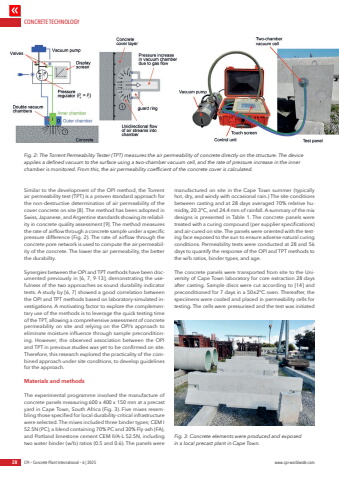
CONCRETE TECHNOLOGY28 CPI %u2013 Concrete Plant International %u2013 6 | 2025 www.cpi-worldwide.comSimilar to the development of the OPI method, the Torrent air permeability test (TPT) is a proven standard approach for the non-destructive determination of air permeability of the cover concrete on site [8]. The method has been adopted in Swiss, Japanese, and Argentine standards showing its reliability in concrete quality assessment [9]. The method measures the rate of airflow through a concrete sample under a specific pressure difference (Fig. 2). The rate of airflow through the concrete pore network is used to compute the air permeability of the concrete. The lower the air permeability, the better the durability.Synergies between the OPI and TPT methods have been documented previously in [6, 7, 9-13], demonstrating the usefulness of the two approaches as sound durability indicator tests. A study by [6, 7] showed a good correlation between the OPI and TPT methods based on laboratory-simulated investigations. A motivating factor to explore the complementary use of the methods is to leverage the quick testing time of the TPT, allowing a comprehensive assessment of concrete permeability on site and relying on the OPI%u2019s approach to eliminate moisture influence through sample preconditioning. However, the observed association between the OPI and TPT in previous studies was yet to be confirmed on site. Therefore, this research explored the practicality of the combined approach under site conditions, to develop guidelines for the approach.Materials and methodsThe experimental programme involved the manufacture of concrete panels measuring 600 x 400 x 150 mm at a precast yard in Cape Town, South Africa (Fig. 3). Five mixes resembling those specified for local durability-critical infrastructure were selected. The mixes included three binder types; CEM I 52.5N (PC), a blend containing 70% PC and 30% Fly-ash (FA), and Portland limestone cement CEM II/A-L 52.5N, including two water binder (w/b) ratios (0.5 and 0.6). The panels were manufactured on site in the Cape Town summer (typically hot, dry, and windy with occasional rain.) The site conditions between casting and at 28 days averaged 70% relative humidity, 20.3%u00b0C, and 24.4 mm of rainfall. A summary of the mix designs is presented in Table 1. The concrete panels were treated with a curing compound (per supplier specifications) and air-cured on site. The panels were oriented with the testing face exposed to the sun to ensure adverse natural curing conditions. Permeability tests were conducted at 28 and 56 days to quantify the response of the OPI and TPT methods to the w/b ratios, binder types, and age.The concrete panels were transported from site to the University of Cape Town laboratory for core extraction 28 days after casting. Sample discs were cut according to [14] and preconditioned for 7 days in a 50%u00b12%u00b0C oven. Thereafter, the specimens were cooled and placed in permeability cells for testing. The cells were pressurised and the test was initiated Fig. 2: The Torrent Permeability Tester (TPT) measures the air permeability of concrete directly on the structure. The device applies a defined vacuum to the surface using a two-chamber vacuum cell, and the rate of pressure increase in the inner chamber is monitored. From this, the air permeability coefficient of the concrete cover is calculated.Fig. 3: Concrete elements were produced and exposed in a local precast plant in Cape Town.


