


Page 32 - Demo
P. 32
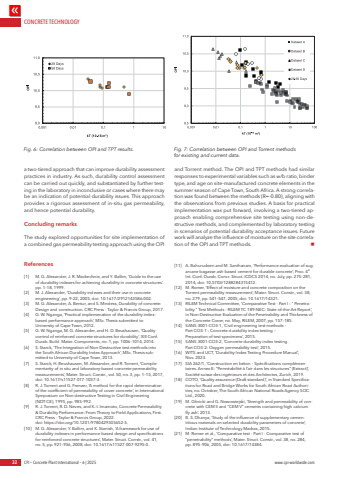
CONCRETE TECHNOLOGY32 CPI %u2013 Concrete Plant International %u2013 6 | 2025 www.cpi-worldwide.coma two-tiered approach that can improve durability assessment practices in industry. As such, durability control assessment can be carried out quickly, and substantiated by further testing in the laboratory in inconclusive or cases where there may be an indication of potential durability issues. This approach provides a rigorous assessment of in-situ gas permeability, and hence potential durability.Concluding remarksThe study explored opportunities for site implementation of a combined gas permeability testing approach using the OPI and Torrent method. The OPI and TPT methods had similar responses to experimental variables such as w/b ratio, binder type, and age on site-manufactured concrete elements in the summer season of Cape Town, South Africa. A strong correlation was found between the methods (R=-0.80), aligning with the observations from previous studies. A basis for practical implementation was put forward, involving a two-tiered approach enabling comprehensive site testing using non-destructive methods, and complemented by laboratory testing in scenarios of potential durability acceptance issues. Future work will analyze the influence of moisture on the site correlation of the OPI and TPT methods. nReferences[1] M. G. Alexander, J. R. Mackechnie, and Y. Ballim, %u2018Guide to the use of durability indexes for achieving durability in concrete structures%u2019. pp. 1%u201318, 1999.[2] M. J. Alexander, %u2018Durability indexes and their use in concrete engineering%u2019, pp. 9%u201322, 2005, doi: 10.1617/2912143586.002.[3] M. G. Alexander, A. Bentur, and S. Mindess, Durability of concrete: Design and construction. CRC Press - Taylor & Francis Group, 2017.[4] G. W. Nganga, %u2018Practical implemenation of the durability indexbased performance approach%u2019, MSc. Thesis submitted to University of Cape Town, 2012.[5] G. W. Nganga, M. G. Alexander, and H. D. Beushausen, %u2018Quality control of reinforced concrete structures for durability%u2019, XIII Conf. Durab. Build. Mater. Components, no. 1, pp. 1006%u20131014, 2014.[6] S. Starck, %u2018The Integration of Non-Destructive test methods into the South African Durability Index Approach%u2019, MSc. Thesis submitted to University of Cape Town, 2013.[7] S. Starck, H. Beushausen, M. Alexander, and R. Torrent, %u2018Complementarity of in situ and laboratory-based concrete permeability measurements%u2019, Mater. Struct. Constr., vol. 50, no. 3, pp. 1%u201315, 2017, doi: 10.1617/s11527-017-1037-3.[8] R. J. Torrent and G. Frenzer, %u2018A method for the rapid determination of the coefficient of permeability of cover concrete%u2019, in International Symposium on Non-destructive Testing in Civil Engineering (NDT-CE), 1995, pp. 985%u2013992.[9] R. J. Torrent, R. D. Neves, and K.-I. Imamoto, Concrete Permeability & Durability Performance: From Theory to Field Applications, First. CRC Press - Taylor & Francis Group, 2022. doi: https://doi.org/10.1201/9780429505652-5.[10] M. G. Alexander, Y. Ballim, and K. Stanish, %u2018A framework for use of durability indexes in performance-based design and specifications for reinforced concrete structures%u2019, Mater. Struct. Constr., vol. 41, no. 5, pp. 921%u2013936, 2008, doi: 10.1617/s11527-007-9295-0.[11] A. Bahurudeen and M. Santhanam, %u2018Performance evaluation of sugarcane bagasse ash-based cement for durable concrete%u2019, Proc. 4thInt. Conf. Durab. Concr. Struct. ICDCS 2014, no. July, pp. 275%u2013281, 2014, doi: 10.5703/1288284315412.[12] M. Romer, %u2018Effect of moisture and concrete composition on the Torrent permeability measurement%u2019, Mater. Struct. Constr., vol. 38, no. 279, pp. 541%u2013547, 2005, doi: 10.1617/14321.[13] RILEM Technical Committee, %u2018Comparative Test - Part I : \bility \in Non-Destructive Evaluation of the Penetrability and Thickness of the Concrete Cover, no. May, RILEM, 2007, pp. 157%u2013185.[14] SANS 3001-CO3-1, %u2018Civil engineering test methods %u2013 Part CO3-1 : Concrete durability index testing %u2013Preparation of test specimens%u2019, 2015.[15] SANS 3001-CO3-2, %u2018Concrete durability index testing. Part CO3-2: Oxygen permeability test%u2019, 2015.[16] WITS and UCT, %u2018Durability Index Testing Procedure Manual%u2019, Nov. 2023.[17] SIA 262/1, %u2018Construction en b%u00e9ton %u2013 Sp%u00e9cifications compl%u00e9mentaires. Annex E: %u201cPerm%u00e9abilit%u00e9 %u00e0 l%u2019air dans les structures%u201d (Extract)%u2019, Soci%u00e9t%u00e9 suisse des ing%u00e9nieurs et des Architectes, Zurich, 2019.[18] COTO, %u2018Quality assurance (Draft standard)%u2019, in Standard Specifications for Road and Bridge Works for South African Road Authorities, no. October, The South African National Roads Agency SOC Ltd., 2020.[19] M. Glinicki and G. Nowowiejski, %u2018Strength and permeability of concrete with CEM II and %u201cCEM V%u201d cements containing high calcium fly ash%u2019. 2013.[20] B. S. Dhanya, %u2018Study of the influence of supplementary cementitious materials on selected durability parameters of concrete%u2019, Indian Institute of Technology Madras, 2015.[21] M. Romer et al., %u2018Comparative test - Part I - Comparative test of %u201cpenetrability%u201d methods%u2019, Mater. Struct. Constr., vol. 38, no. 284, pp. 895%u2013906, 2005, doi: 10.1617/14384.Fig. 6: Correlation between OPI and TPT results. Fig. 7: Correlation between OPI and Torrent methods for existing and current data.


