


Page 30 - Demo
P. 30
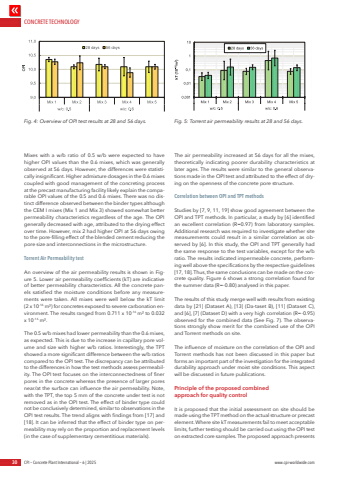
CONCRETE TECHNOLOGY30 CPI %u2013 Concrete Plant International %u2013 6 | 2025 www.cpi-worldwide.comMixes with a w/b ratio of 0.5 w/b were expected to have higher OPI values than the 0.6 mixes, which was generally observed at 56 days. However, the differences were statistically insignificant. Higher admixture dosages in the 0.6 mixes coupled with good management of the concreting process at the precast manufacturing facility likely explain the comparable OPI values of the 0.5 and 0.6 mixes. There was no distinct difference observed between the binder types although the CEM I mixes (Mix 1 and Mix 3) showed somewhat better permeability characteristics regardless of the age. The OPI generally decreased with age, attributed to the drying effect over time. However, mix 2 had higher OPI at 56 days owing to the pore-filling effect of the blended cement reducing the pore size and interconnections in the microstructure.Torrent Air Permeability testAn overview of the air permeability results is shown in Figure 5. Lower air permeability coefficients (kT) are indicative of better permeability characteristics. All the concrete panels satisfied the moisture conditions before any measurements were taken. All mixes were well below the kT limit (2 x 10-16 m%u00b2) for concretes exposed to severe carbonation environment. The results ranged from 0.711 x 10⁻¹⁶ m%u00b2 to 0.032 x 10⁻¹⁶ m%u00b2.The 0.5 w/b mixes had lower permeability than the 0.6 mixes, as expected. This is due to the increase in capillary pore volume and size with higher w/b ratios. Interestingly, the TPT showed a more significant difference between the w/b ratios compared to the OPI test. The discrepancy can be attributed to the differences in how the test methods assess permeability. The OPI test focuses on the interconnectedness of finer pores in the concrete whereas the presence of larger pores near/at the surface can influence the air permeability. Note, with the TPT, the top 5 mm of the concrete under test is not removed as in the OPI test. The effect of binder type could not be conclusively determined, similar to observations in the OPI test results. The trend aligns with findings from [17] and [18]. It can be inferred that the effect of binder type on permeability may rely on the proportion and replacement levels (in the case of supplementary cementitious materials).The air permeability increased at 56 days for all the mixes, theoretically indicating poorer durability characteristics at later ages. The results were similar to the general observations made in the OPI test and attributed to the effect of drying on the openness of the concrete pore structure.Correlation between OPI and TPT methodsStudies by [7, 9, 11, 19] show good agreement between the OPI and TPT methods. In particular, a study by [6] identified an excellent correlation (R=0.97) from laboratory samples. Additional research was required to investigate whether site measurements could result in a similar correlation as observed by [6]. In this study, the OPI and TPT generally had the same response to the test variables, except for the w/b ratio. The results indicated impermeable concrete, performing well above the specifications by the respective guidelines [17, 18]. Thus, the same conclusions can be made on the concrete quality. Figure 6 shows a strong correlation found for the summer data (R=-0.80) analysed in this paper.The results of this study merge well with results from existing data by [21] (Dataset A), [13] (Da-taset B), [11] (Dataset C), and [6], [7] (Dataset D) with a very high correlation (R=-0.95) observed for the combined data (See Fig. 7). The observations strongly show merit for the combined use of the OPI and Torrent methods on site. The influence of moisture on the correlation of the OPI and Torrent methods has not been discussed in this paper but forms an important part of the investigation for the integrated durability approach under moist site conditions. This aspect will be discussed in future publications.Principle of the proposed combined approach for quality controlIt is proposed that the initial assessment on site should be made using the TPT method on the actual structure or precast element. Where site kT measurements fail to meet acceptable limits, further testing should be carried out using the OPI test on extracted core samples. The proposed approach presents Fig. 4: Overview of OPI test results at 28 and 56 days. Fig. 5: Torrent air permeability results at 28 and 56 days.


