


Page 36 - Demo
P. 36
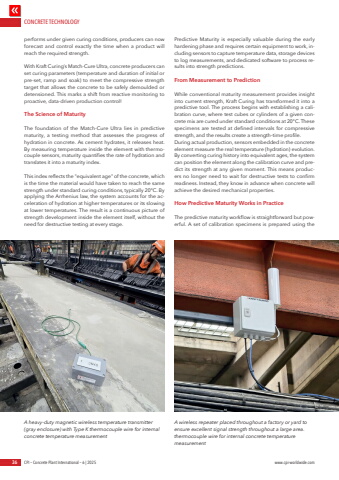
CONCRETE TECHNOLOGY36 CPI %u2013 Concrete Plant International %u2013 6 | 2025 www.cpi-worldwide.comperforms under given curing conditions, producers can now forecast and control exactly the time when a product will reach the required strength.With Kraft Curing%u2019s Match-Cure Ultra, concrete producers can set curing parameters (temperature and duration of initial or pre-set, ramp and soak) to meet the compressive strength target that allows the concrete to be safely demoulded or detensioned. This marks a shift from reactive monitoring to proactive, data-driven production control!The Science of MaturityThe foundation of the Match-Cure Ultra lies in predictive maturity, a testing method that assesses the progress of hydration in concrete. As cement hydrates, it releases heat. By measuring temperature inside the element with thermocouple sensors, maturity quantifies the rate of hydration and translates it into a maturity index.This index reflects the \is the time the material would have taken to reach the same strength under standard curing conditions, typically 20%u00b0C. By applying the Arrhenius law, the system accounts for the acceleration of hydration at higher temperatures or its slowing at lower temperatures. The result is a continuous picture of strength development inside the element itself, without the need for destructive testing at every stage.Predictive Maturity is especially valuable during the early hardening phase and requires certain equipment to work, including sensors to capture temperature data, storage devices to log measurements, and dedicated software to process results into strength predictions.From Measurement to PredictionWhile conventional maturity measurement provides insight into current strength, Kraft Curing has transformed it into a predictive tool. The process begins with establishing a calibration curve, where test cubes or cylinders of a given concrete mix are cured under standard conditions at 20%u00b0C. These specimens are tested at defined intervals for compressive strength, and the results create a strength%u2013time profile.During actual production, sensors embedded in the concrete element measure the real temperature (hydration) evolution. By converting curing history into equivalent ages, the system can position the element along the calibration curve and predict its strength at any given moment. This means producers no longer need to wait for destructive tests to confirm readiness. Instead, they know in advance when concrete will achieve the desired mechanical properties.How Predictive Maturity Works in PracticeThe predictive maturity workflow is straightforward but powerful. A set of calibration specimens is prepared using the A heavy-duty magnetic wireless temperature transmitter (gray enclosure) with Type K thermocouple wire for internal concrete temperature measurementA wireless repeater placed throughout a factory or yard to ensure excellent signal strength throughout a large area. thermocouple wire for internal concrete temperature measurement


