


Page 138 - Demo
P. 138
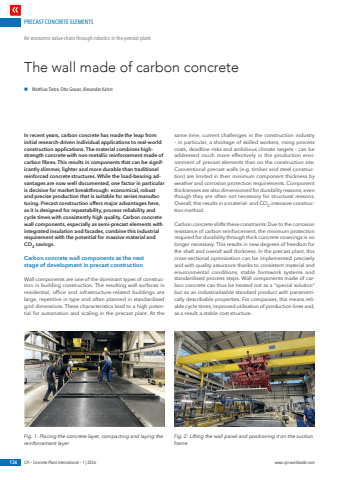
PRECAST CONCRETE ELEMENTS136 CPI %u2013 Concrete Plant International %u2013 1 | 2026 www.cpi-worldwide.comIn recent years, carbon concrete has made the leap from initial research-driven individual applications to real-world construction applications. The material combines highstrength concrete with non-metallic reinforcement made of carbon fibres. This results in components that can be significantly slimmer, lighter and more durable than traditional reinforced concrete structures. While the load-bearing advantages are now well documented, one factor in particular is decisive for market breakthrough: economical, robust and precise production that is suitable for series manufacturing. Precast construction offers major advantages here, as it is designed for repeatability, process reliability and cycle times with consistently high quality. Carbon concrete wall components, especially as semi-precast elements with integrated insulation and facades, combine this industrial requirement with the potential for massive material and CO2 savings.Carbon concrete wall components as the next stage of development in precast constructionWall components are one of the dominant types of construction in building construction. The resulting wall surfaces in residential, office and infrastructure-related buildings are large, repetitive in type and often planned in standardised grid dimensions. These characteristics lead to a high potential for automation and scaling in the precast plant. At the same time, current challenges in the construction industry %u2013 in particular, a shortage of skilled workers, rising process costs, deadline risks and ambitious climate targets %u2013 can be addressed much more effectively in the production environment of precast elements than on the construction site. Conventional precast walls (e.g. timber and steel construction) are limited in their minimum component thickness by weather and corrosion protection requirements. Component thicknesses are also dimensioned for durability reasons, even though they are often not necessary for structural reasons. Overall, this results in a material- and CO2-intensive construction method.Carbon concrete shifts these constraints. Due to the corrosion resistance of carbon reinforcement, the minimum protection required for durability through thick concrete coverings is no longer necessary. This results in new degrees of freedom for the shell and overall wall thickness. In the precast plant, this cross-sectional optimisation can be implemented precisely and with quality assurance thanks to consistent material and environmental conditions, stable formwork systems and standardised process steps. Wall components made of carbon concrete can thus be treated not as a \but as an industrialisable standard product with parametrically describable properties. For companies, this means reliable cycle times, improved utilisation of production lines and, as a result, a stable cost structure.The wall made of carbon concreteAn economic value chain through robotics in the precast plantn Matthias Tietze, Otto Grauer, Alexander KahntFig. 1: Placing the concrete layer, compacting and laying the reinforcement layerFig. 2: Lifting the wall panel and positioning it on the suction frame


