


Page 32 - Demo
P. 32
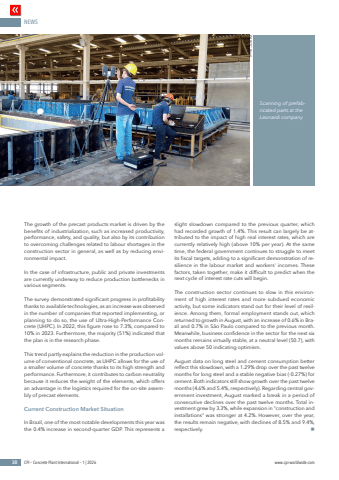
NEWS30 CPI %u2013 Concrete Plant International %u2013 1 | 2026 www.cpi-worldwide.comThe growth of the precast products market is driven by the benefits of industrialization, such as increased productivity, performance, safety, and quality, but also by its contribution to overcoming challenges related to labour shortages in the construction sector in general, as well as by reducing environmental impact.In the case of infrastructure, public and private investments are currently underway to reduce production bottlenecks in various segments.The survey demonstrated significant progress in profitability thanks to available technologies, as an increase was observed in the number of companies that reported implementing, or planning to do so, the use of Ultra-High-Performance Concrete (UHPC). In 2022, this figure rose to 7.3%, compared to 10% in 2023. Furthermore, the majority (51%) indicated that the plan is in the research phase.This trend partly explains the reduction in the production volume of conventional concrete, as UHPC allows for the use of a smaller volume of concrete thanks to its high strength and performance. Furthermore, it contributes to carbon neutrality because it reduces the weight of the elements, which offers an advantage in the logistics required for the on-site assembly of precast elements.Current Construction Market SituationIn Brazil, one of the most notable developments this year was the 0.4% increase in second-quarter GDP. This represents a slight slowdown compared to the previous quarter, which had recorded growth of 1.4%. This result can largely be attributed to the impact of high real interest rates, which are currently relatively high (above 10% per year). At the same time, the federal government continues to struggle to meet its fiscal targets, adding to a significant demonstration of resilience in the labour market and workers' incomes. These factors, taken together, make it difficult to predict when the next cycle of interest rate cuts will begin.The construction sector continues to slow in this environment of high interest rates and more subdued economic activity, but some indicators stand out for their level of resilience. Among them, formal employment stands out, which returned to growth in August, with an increase of 0.6% in Brazil and 0.7% in S%u00e3o Paulo compared to the previous month. Meanwhile, business confidence in the sector for the next six months remains virtually stable, at a neutral level (50.7), with values above 50 indicating optimism.August data on long steel and cement consumption better reflect this slowdown, with a 1.29% drop over the past twelve months for long steel and a stable negative bias (-0.27%) for cement. Both indicators still show growth over the past twelve months (4.6% and 5.4%, respectively). Regarding central government investment, August marked a break in a period of consecutive declines over the past twelve months. Total investment grew by 3.3%, while expansion in \installations\the results remain negative, with declines of 8.5% and 9.4%, respectively. nScanning of prefabricated parts at the Leonardi company%u00a9ABCIC Brazil


