


Page 58 - Demo
P. 58
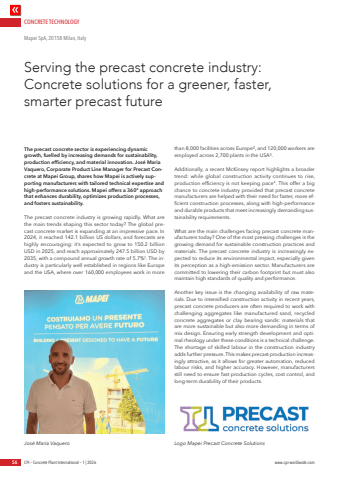
CONCRETE TECHNOLOGY56 CPI %u2013 Concrete Plant International %u2013 1 | 2026 www.cpi-worldwide.comThe precast concrete sector is experiencing dynamic growth, fuelled by increasing demands for sustainability, production efficiency, and material innovation. Jos%u00e9 Maria Vaquero, Corporate Product Line Manager for Precast Concrete at Mapei Group, shares how Mapei is actively supporting manufacturers with tailored technical expertise and high-performance solutions. Mapei offers a 360%u00b0 approach that enhances durability, optimizes production processes, and fosters sustainability.The precast concrete industry is growing rapidly. What are the main trends shaping this sector today? The global precast concrete market is expanding at an impressive pace. In 2024, it reached 142.1 billion US dollars, and forecasts are highly encouraging: it%u2019s expected to grow to 150.2 billion USD in 2025, and reach approximately 247.5 billion USD by 2035, with a compound annual growth rate of 5.7%%u00b9. The industry is particularly well established in regions like Europe and the USA, where over 160,000 employees work in more than 8,000 facilities across Europe%u00b2, and 120,000 workers are employed across 2,700 plants in the USA%u00b3. Additionally, a recent McKinsey report highlights a broader trend: while global construction activity continues to rise, production efficiency is not keeping pace4. This offer a big chance to concrete industry provided that precast concrete manufacturers are helped with their need for faster, more efficient construction processes, along with high-performance and durable products that meet increasingly demanding sustainability requirements.What are the main challenges facing precast concrete manufacturers today? One of the most pressing challenges is the growing demand for sustainable construction practices and materials. The precast concrete industry is increasingly expected to reduce its environmental impact, especially given its perception as a high-emission sector. Manufacturers are committed to lowering their carbon footprint but must also maintain high standards of quality and performance.Another key issue is the changing availability of raw materials. Due to intensified construction activity in recent years, precast concrete producers are often required to work with challenging aggregates like manufactured sand, recycled concrete aggregates or clay bearing sands: materials that are more sustainable but also more demanding in terms of mix design. Ensuring early strength development and optimal rheology under these conditions is a technical challenge.The shortage of skilled labour in the construction industry adds further pressure. This makes precast production increasingly attractive, as it allows for greater automation, reduced labour risks, and higher accuracy. However, manufacturers still need to ensure fast production cycles, cost control, and long-term durability of their products.Serving the precast concrete industry: Concrete solutions for a greener, faster, smarter precast futureMapei SpA, 20158 Milan, Italy Jos%u00e9 Maria Vaquero Logo Mapei Precast Concrete Solutions


