


Page 56 - Demo
P. 56
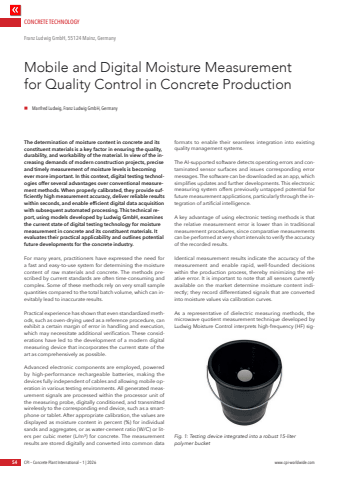
CONCRETE TECHNOLOGY54 CPI %u2013 Concrete Plant International %u2013 1 | 2026 www.cpi-worldwide.comThe determination of moisture content in concrete and its constituent materials is a key factor in ensuring the quality, durability, and workability of the material. In view of the increasing demands of modern construction projects, precise and timely measurement of moisture levels is becoming ever more important. In this context, digital testing technologies offer several advantages over conventional measurement methods. When properly calibrated, they provide sufficiently high measurement accuracy, deliver reliable results within seconds, and enable efficient digital data acquisition with subsequent automated processing. This technical report, using models developed by Ludwig GmbH, examines the current state of digital testing technology for moisture measurement in concrete and its constituent materials. It evaluates their practical applicability and outlines potential future developments for the concrete industry.For many years, practitioners have expressed the need for a fast and easy-to-use system for determining the moisture content of raw materials and concrete. The methods prescribed by current standards are often time-consuming and complex. Some of these methods rely on very small sample quantities compared to the total batch volume, which can inevitably lead to inaccurate results.Practical experience has shown that even standardized methods, such as oven-drying used as a reference procedure, can exhibit a certain margin of error in handling and execution, which may necessitate additional verification. These considerations have led to the development of a modern digital measuring device that incorporates the current state of the art as comprehensively as possible.Advanced electronic components are employed, powered by high-performance rechargeable batteries, making the devices fully independent of cables and allowing mobile operation in various testing environments. All generated measurement signals are processed within the processor unit of the measuring probe, digitally conditioned, and transmitted wirelessly to the corresponding end device, such as a smartphone or tablet. After appropriate calibration, the values are displayed as moisture content in percent (%) for individual sands and aggregates, or as water-cement ratio (W/C) or liters per cubic meter (L/m%u00b3) for concrete. The measurement results are stored digitally and converted into common data formats to enable their seamless integration into existing quality management systems.The AI-supported software detects operating errors and contaminated sensor surfaces and issues corresponding error messages. The software can be downloaded as an app, which simplifies updates and further developments. This electronic measuring system offers previously untapped potential for future measurement applications, particularly through the integration of artificial intelligence.A key advantage of using electronic testing methods is that the relative measurement error is lower than in traditional measurement procedures, since comparative measurements can be performed at very short intervals to verify the accuracy of the recorded results.Identical measurement results indicate the accuracy of the measurement and enable rapid, well-founded decisions within the production process, thereby minimizing the relative error. It is important to note that all sensors currently available on the market determine moisture content indirectly; they record differentiated signals that are converted into moisture values via calibration curves.As a representative of dielectric measuring methods, the microwave quotient measurement technique developed by Ludwig Moisture Control interprets high-frequency (HF) sigMobile and Digital Moisture Measurement for Quality Control in Concrete ProductionFranz Ludwig GmbH, 55124 Mainz, Germanyn Manfred Ludwig, Franz Ludwig GmbH, GermanyFig. 1: Testing device integrated into a robust 15-liter polymer bucket


