


Page 146 - Demo
P. 146
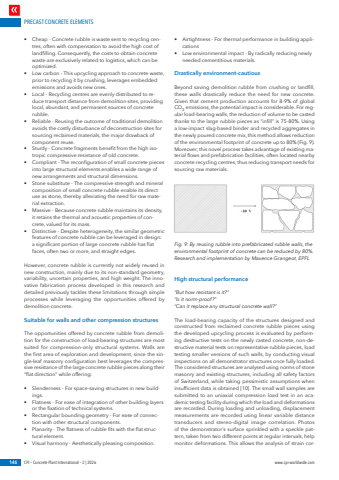
PRECAST CONCRETE ELEMENTS146 CPI %u2013 Concrete Plant International %u2013 2 | 2026 www.cpi-worldwide.com%u2022 Cheap - Concrete rubble is waste sent to recycling centres, often with compensation to avoid the high cost of landfilling. Consequently, the costs to obtain concrete waste are exclusively related to logistics, which can be optimized.%u2022 Low carbon - This upcycling approach to concrete waste, prior to recycling it by crushing, leverages embedded emissions and avoids new ones.%u2022 Local - Recycling centres are evenly distributed to reduce transport distance from demolition sites, providing local, abundant, and permanent sources of concrete rubble.%u2022 Reliable - Reusing the outcome of traditional demolition avoids the costly disturbance of deconstruction sites for sourcing reclaimed materials, the major drawback of component reuse.%u2022 Sturdy - Concrete fragments benefit from the high isotropic compressive resistance of old concrete.%u2022 Compliant - The reconfiguration of small concrete pieces into large structural elements enables a wide range of new arrangements and structural dimensions.%u2022 Stone substitute - The compressive strength and mineral composition of small concrete rubble enable its direct use as stone, thereby alleviating the need for raw material extraction.%u2022 Massive - Because concrete rubble maintains its density, it retains the thermal and acoustic properties of concrete, valued for its mass.%u2022 Distinctive - Despite heterogeneity, the similar geometric features of concrete rubble can be leveraged in design: a significant portion of large concrete rubble has flat faces, often two or more, and straight edges.However, concrete rubble is currently not widely reused in new construction, mainly due to its non-standard geometry, variability, uncertain properties, and high weight. The innovative fabrication process developed in this research and detailed previously tackles these limitations through simple processes while leveraging the opportunities offered by demolition concrete.Suitable for walls and other compression structuresThe opportunities offered by concrete rubble from demolition for the construction of load-bearing structures are most suited for compression-only structural systems. Walls are the first area of exploration and development, since the single-leaf masonry configuration best leverages the compressive resistance of the large concrete rubble pieces along their %u201cflat direction%u201d while offering:%u2022 Slenderness - For space-saving structures in new buildings.%u2022 Flatness - For ease of integration of other building layers or the fixation of technical systems.%u2022 Rectangular bounding geometry - For ease of connection with other structural components.%u2022 Planarity - The flatness of rubble fits with the flat structural element.%u2022 Visual harmony - Aesthetically pleasing composition.%u2022 Airtightness - For thermal performance in building applications%u2022 Low environmental impact - By radically reducing newly needed cementitious materials.Drastically environment-cautiousBeyond saving demolition rubble from crushing or landfill, these walls drastically reduce the need for new concrete. Given that cement production accounts for 8-9% of global CO2 emissions, the potential impact is considerable. For regular load-bearing walls, the reduction of volume to be casted thanks to the large rubble pieces as %u201cinfill%u201d is 75-80%. Using a low-impact slag-based binder and recycled aggregates in the newly poured concrete mix, this method allows reduction of the environmental footprint of concrete up to 80% (Fig. 9). Moreover, this novel process takes advantage of existing material flows and prefabrication facilities, often located nearby concrete recycling centres, thus reducing transport needs for sourcing raw materials.High structural performance%u201cBut how resistant is it?%u201d%u201cIs it norm-proof?%u201d%u201cCan it replace any structural concrete wall?%u201dThe load-bearing capacity of the structures designed and constructed from reclaimed concrete rubble pieces using the developed upcycling process is evaluated by performing destructive tests on the newly casted concrete, non-destructive material tests on representative rubble pieces, load testing smaller versions of such walls, by conducting visual inspections on all demonstrator structures once fully loaded. The considered structures are analysed using norms of stone masonry and existing structures, including all safety factors of Switzerland, while taking pessimistic assumptions when insufficient data is obtained [10]. The small wall samples are submitted to an uniaxial compression load test in an academic testing facility during which the load and deformations are recorded. During loading and unloading, displacement measurements are recorded using linear variable distance transducers and stereo-digital image correlation. Photos of the demonstrator%u2019s surface sprinkled with a speckle pattern, taken from two different points at regular intervals, help monitor deformations. This allows the analysis of strain corFig. 9: By reusing rubble into prefabricated rubble walls, the environmental footprint of concrete can be reduced by 80%. Research and implementation by Maxence Grangeot, EPFL


