


Page 34 - Demo
P. 34
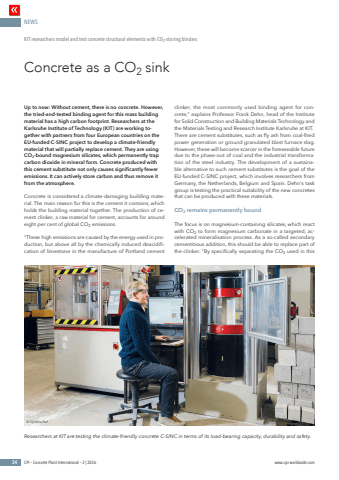
NEWS34 CPI %u2013 Concrete Plant International %u2013 2 | 2026 www.cpi-worldwide.comUp to no Without cement, there is no concrete. However, the tried-and-tested binding agent for this mass building material has a high carbon footprint. Researchers at the Karlsruhe Institute of Technology (KIT) are working together with partners from four European countries on the EU-funded C-SINC project to develop a climate-friendly material that will partially replace cement. They are using CO2-bound magnesium silicates, which permanently trap carbon dioxide in mineral form. Concrete produced with this cement substitute not only causes significantly fewer emissions. It can actively store carbon and thus remove it from the atmosphere.Concrete is considered a climate-damaging building material. The main reason for this is the cement it contains, which holds the building material together. The production of cement clinker, a raw material for cement, accounts for around eight per cent of global CO2 emissions.\duction, but above all by the chemically induced deacidification of limestone in the manufacture of Portland cement clinker, the most commonly used binding agent for concrete,\for Solid Construction and Building Materials Technology and the Materials Testing and Research Institute Karlsruhe at KIT.There are cement substitutes, such as fly ash from coal-fired power generation or ground granulated blast furnace slag. However, these will become scarcer in the foreseeable future due to the phase-out of coal and the industrial transformation of the steel industry. The development of a sustainable alternative to such cement substitutes is the goal of the EU-funded C-SINC project, which involves researchers from Germany, the Netherlands, Belgium and Spain. Dehn's task group is testing the practical suitability of the new concretes that can be produced with these materials.CO2 remains permanently boundThe focus is on magnesium-containing silicates, which react with CO2 to form magnesium carbonate in a targeted, accelerated mineralisation process. As a so-called secondary cementitious addition, this should be able to replace part of the clinker. \Concrete as a CO2 sinkKIT researchers model and test concrete structural elements with CO2-storing binders%u00a9 Cynthia RufResearchers at KIT are testing the climate-friendly concrete C-SINC in terms of its load-bearing capacity, durability and safety.


