


Page 50 - Demo
P. 50
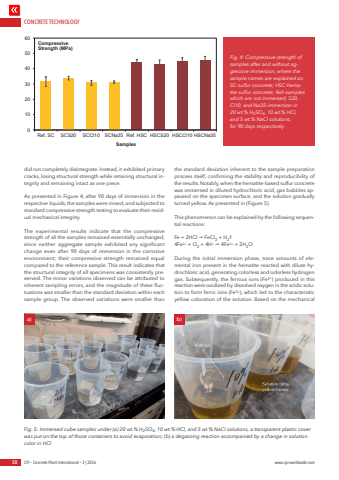
CONCRETE TECHNOLOGY50 CPI %u2013 Concrete Plant International %u2013 2 | 2026 www.cpi-worldwide.comdid not completely disintegrate. Instead, it exhibited primary cracks, losing structural strength while retaining structural integrity and remaining intact as one piece.As presented in Figure 4, after 90 days of immersion in the respective liquids, the samples were rinsed, and subjected to standard compressive strength testing to evaluate their residual mechanical integrity. The experimental results indicate that the compressive strength of all the samples remained essentially unchanged, since neither aggregate sample exhibited any significant change even after 90 days of immersion in the corrosive environment; their compressive strength remained equal compared to the reference sample. This result indicates that the structural integrity of all specimens was consistently preserved. The minor variations observed can be attributed to inherent sampling errors, and the magnitude of these fluctuations was smaller than the standard deviation within each sample group. The observed variations were smaller than the standard deviation inherent to the sample preparation process itself, confirming the stability and reproducibility of the results. Notably, when the hematite-based sulfur concrete was immersed in diluted hydrochloric acid, gas bubbles appeared on the specimen surface, and the solution gradually turned yellow. As presented in (Figure 5).This phenomenon can be explained by the following sequential reactions:Fe + 2HCl %uf08e FeCl2 + H2%uf08f4Fe2+ + O2 + 4H+ %uf08e 4Fe3+ + 2H2ODuring the initial immersion phase, trace amounts of elemental iron present in the hematite reacted with dilute hydrochloric acid, generating colorless and odorless hydrogen gas. Subsequently, the ferrous ions (Fe%u00b2+) produced in this reaction were oxidized by dissolved oxygen in the acidic solution to form ferric ions (Fe%u00b3+), which led to the characteristic yellow coloration of the solution. Based on the mechanical 0102030405060Ref. SC SCS20 SCCl10 SCNa35 Ref. HSC HSCS20 HSCCl10 HSCNa35Compressive Strength (MPa)SamplesFig. 4: Compressive strength of samples after and without aggressive immersion, where the sample names are explained as: SC-sulfur concrete; HSC-hematite sulfur concrete; Ref.-samples which are not immersed; S20, Cl10, and Na35-immersion in 20 wt.% H2SO4, 10 wt.% HCl, and 5 wt.% NaCl solutions, for 90 days respectivelyFig. 5: Immersed cube samples under (a) 20 wt.% H2SO4, 10 wt.% HCl, and 5 wt.% NaCl solutions, a transparent plastic cover was put on the top of those containers to avoid evaporation; (b) a degassing reaction accompanied by a change in solution color in HCla) b)


