


Page 46 - Demo
P. 46
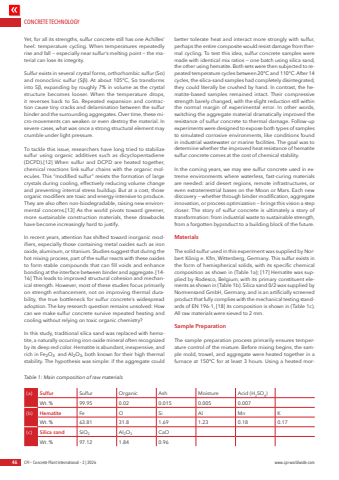
CONCRETE TECHNOLOGY46 CPI %u2013 Concrete Plant International %u2013 2 | 2026 www.cpi-worldwide.comYet, for all its strengths, sulfur concrete still has one Achilles%u2019 heel: temperature cycling. When temperatures repeatedly rise and fall %u2014 especially near sulfur%u2019s melting point %u2014 the material can lose its integrity. Sulfur exists in several crystal forms, orthorhombic sulfur (S%u03b1) and monoclinic sulfur (S%u03b2). At about 105%u00b0C, S%u03b1 transforms into S%u03b2, expanding by roughly 7% in volume as the crystal structure becomes looser. When the temperature drops, it reverses back to S%u03b1. Repeated expansion and contraction cause tiny cracks and delamination between the sulfur binder and the surrounding aggregates. Over time, these micro-movements can weaken or even destroy the material. In severe cases, what was once a strong structural element may crumble under light pressure.To tackle this issue, researchers have long tried to stabilize sulfur using organic additives such as dicyclopentadiene (DCPD).[12] When sulfur and DCPD are heated together, chemical reactions link sulfur chains with the organic molecules. This %u201cmodified sulfur%u201d resists the formation of large crystals during cooling, effectively reducing volume change and preventing internal stress buildup. But at a cost, those organic modifiers are toxic and energy-intensive to produce. They are also often non-biodegradable, raising new environmental concerns.[13] As the world pivots toward greener, more sustainable construction materials, these drawbacks have become increasingly hard to justify.In recent years, attention has shifted toward inorganic modifiers, especially those containing metal oxides such as iron oxide, aluminum, or titanium. Studies suggest that during the hot mixing process, part of the sulfur reacts with these oxides to form stable compounds that can fill voids and enhance bonding at the interface between binder and aggregate. [14-16] This leads to improved structural cohesion and mechanical strength. However, most of these studies focus primarily on strength enhancement, not on improving thermal durability, the true bottleneck for sulfur concrete%u2019s widespread adoption. The key research question remains unsolved: How can we make sulfur concrete survive repeated heating and cooling without relying on toxic organic chemistry?In this study, traditional silica sand was replaced with hematite, a naturally occurring iron oxide mineral often recognized by its deep red color. Hematite is abundant, inexpensive, and rich in Fe2O3 and Al2O3, both known for their high thermal stability. The hypothesis was simple: if the aggregate could better tolerate heat and interact more strongly with sulfur, perhaps the entire composite would resist damage from thermal cycling. To test this idea, sulfur concrete samples were made with identical mix ratios %u2014 one batch using silica sand, the other using hematite. Both sets were then subjected to repeated temperature cycles between 20%u00b0C and 110%u00b0C. After 14 cycles, the silica-sand samples had completely disintegrated, they could literally be crushed by hand. In contrast, the hematite-based samples remained intact. Their compressive strength barely changed, with the slight reduction still within the normal margin of experimental error. In other words, switching the aggregate material dramatically improved the resistance of sulfur concrete to thermal damage. Follow-up experiments were designed to expose both types of samples to simulated corrosive environments, like conditions found in industrial wastewater or marine facilities. The goal was to determine whether the improved heat resistance of hematite sulfur concrete comes at the cost of chemical stability.In the coming years, we may see sulfur concrete used in extreme environments where waterless, fast-curing materials are needed: arid desert regions, remote infrastructures, or even extraterrestrial bases on the Moon or Mars. Each new discovery %u2014 whether through binder modification, aggregate innovation, or process optimization %u2014 brings this vision a step closer. The story of sulfur concrete is ultimately a story of transformation: from industrial waste to sustainable strength, from a forgotten byproduct to a building block of the future.MaterialsThe solid sulfur used in this experiment was supplied by Norbert K%u00f6nig e. Kfm, Wittenberg, Germany. This sulfur exists in the form of hemispherical solids, with its specific chemical composition as shown in (Table 1a); [17] Hematite was supplied by Rodesco, Belgium, with its primary constituent elements as shown in (Table 1b). Silica sand 0/2 was supplied by Normensand GmbH, Germany, and is an artificially screened product that fully complies with the mechanical testing standards of EN 196-1, [18] its composition is shown in (Table 1c). All raw materials were sieved to 2 mm. Sample PreparationThe sample preparation process primarily ensures temperature control of the mixture. Before mixing begins, the sample mold, trowel, and aggregate were heated together in a furnace at 150%u00b0C for at least 3 hours. Using a heated morTable 1: Main composition of raw materials(a) Sulfur Sulfur Organic Ash Moisture Acid (H2SO4)Wt. % 99.95 0.02 0.015 0.005 0.007(b) Hematite Fe O Si Al Mn KWt. % 63.81 31.8 1.69 1.23 0.18 0.17(c) Silica sand SiO2 Al2O3 CaOWt. % 97.12 1.84 0.96


