


Page 94 - Demo
P. 94
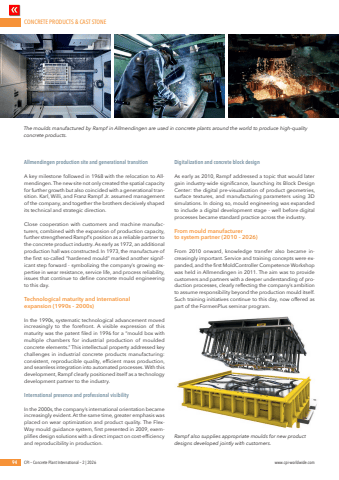
CONCRETE PRODUCTS & CAST STONE94 CPI %u2013 Concrete Plant International %u2013 2 | 2026 www.cpi-worldwide.comAllmendingen production site and generational transitionA key milestone followed in 1968 with the relocation to Allmendingen. The new site not only created the spatial capacity for further growth but also coincided with a generational transition. Karl, Willi, and Franz Rampf Jr. assumed management of the company, and together the brothers decisively shaped its technical and strategic direction.Close cooperation with customers and machine manufacturers, combined with the expansion of production capacity, further strengthened Rampf%u2019s position as a reliable partner to the concrete product industry. As early as 1972, an additional production hall was constructed. In 1973, the manufacture of the first so-called %u201chardened mould%u201d marked another significant step forward - symbolizing the company%u2019s growing expertise in wear resistance, service life, and process reliability, issues that continue to define concrete mould engineering to this day.Technological maturity and international expansion (1990s - 2000s)In the 1990s, systematic technological advancement moved increasingly to the forefront. A visible expression of this maturity was the patent filed in 1996 for a %u201cmould box with multiple chambers for industrial production of moulded concrete elements.%u201d This intellectual property addressed key challenges in industrial concrete products manufacturing: consistent, reproducible quality, efficient mass production, and seamless integration into automated processes. With this development, Rampf clearly positioned itself as a technology development partner to the industry.International presence and professional visibilityIn the 2000s, the company%u2019s international orientation became increasingly evident. At the same time, greater emphasis was placed on wear optimization and product quality. The FlexWay mould guidance system, first presented in 2009, exemplifies design solutions with a direct impact on cost-efficiency and reproducibility in production.Digitalization and concrete block designAs early as 2010, Rampf addressed a topic that would later gain industry-wide significance, launching its Block Design Center: the digital pre-visualization of product geometries, surface textures, and manufacturing parameters using 3D simulations. In doing so, mould engineering was expanded to include a digital development stage - well before digital processes became standard practice across the industry.From mould manufacturer to system partner (2010 - 2026)From 2010 onward, knowledge transfer also became increasingly important. Service and training concepts were expanded, and the first MoldController Competence Workshop was held in Allmendingen in 2011. The aim was to provide customers and partners with a deeper understanding of production processes, clearly reflecting the company%u2019s ambition to assume responsibility beyond the production mould itself. Such training initiatives continue to this day, now offered as part of the FormenPlus seminar program.The moulds manufactured by Rampf in Allmendingen are used in concrete plants around the world to produce high-quality concrete products.Rampf also supplies appropriate moulds for new product designs developed jointly with customers.


