


Page 46 - Demo
P. 46
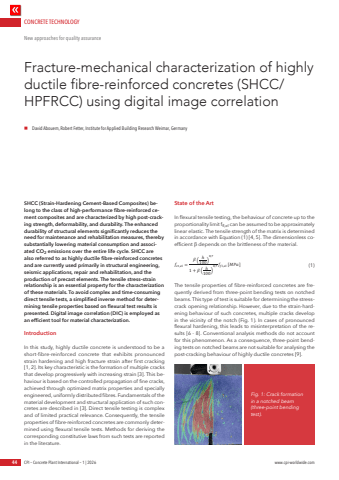
CONCRETE TECHNOLOGY44 CPI %u2013 Concrete Plant International %u2013 1 | 2026 www.cpi-worldwide.comSHCC (Strain-Hardening Cement-Based Composites) belong to the class of high-performance fibre-reinforced cement composites and are characterized by high post-cracking strength, deformability, and durability. The enhanced durability of structural elements significantly reduces the need for maintenance and rehabilitation measures, thereby substantially lowering material consumption and associated CO2 emissions over the entire life cycle. SHCC are also referred to as highly ductile fibre-reinforced concretes and are currently used primarily in structural engineering, seismic applications, repair and rehabilitation, and the production of precast elements. The tensile stress%u2013strain relationship is an essential property for the characterization of these materials. To avoid complex and time-consuming direct tensile tests, a simplified inverse method for determining tensile properties based on flexural test results is presented. Digital image correlation (DIC) is employed as an efficient tool for material characterization.IntroductionIn this study, highly ductile concrete is understood to be a short-fibre-reinforced concrete that exhibits pronounced strain hardening and high fracture strain after first cracking [1, 2]. Its key characteristic is the formation of multiple cracks that develop progressively with increasing strain [3]. This behaviour is based on the controlled propagation of fine cracks, achieved through optimized matrix properties and specially engineered, uniformly distributed fibres. Fundamentals of the material development and structural application of such concretes are described in [3]. Direct tensile testing is complex and of limited practical relevance. Consequently, the tensile properties of fibre-reinforced concretes are commonly determined using flexural tensile tests. Methods for deriving the corresponding constitutive laws from such tests are reported in the literature.State of the ArtIn flexural tensile testing, the behaviour of concrete up to the proportionality limit ffl,el can be assumed to be approximately linear elastic. The tensile strength of the matrix is determined in accordance with Equation (1) [4, 5]. The dimensionless coefficient %u03b2 depends on the brittleness of the material.(1)The tensile properties of fibre-reinforced concretes are frequently derived from three-point bending tests on notched beams. This type of test is suitable for determining the stress%u2013crack opening relationship. However, due to the strain-hardening behaviour of such concretes, multiple cracks develop in the vicinity of the notch (Fig. 1). In cases of pronounced flexural hardening, this leads to misinterpretation of the results [6 - 8]. Conventional analysis methods do not account for this phenomenon. As a consequence, three-point bending tests on notched beams are not suitable for analysing the post-cracking behaviour of highly ductile concretes [9].Fracture-mechanical characterization of highly ductile fibre-reinforced concretes (SHCC/ HPFRCC) using digital image correlationNew approaches for quality assurancen David Abouem, Robert Fetter, Institute for Applied Building Research Weimar, Germany %ud835%udc53%ud835%udc53!\%ud835%udefd%ud835%udefd $ %u210e100(&,'1 + %ud835%udefd%ud835%udefd $ %u210e100(&,' %ud835%udc53%ud835%udc53(%,$% [%ud835%udc40%ud835%udc40%ud835%udc40%ud835%udc40%ud835%udc40%ud835%udc40] %ud835%udf05%ud835%udf05 =%ud835%udf0b%ud835%udf0b2 %u2212 arctan (%ud835%udc4e%ud835%udc4e) %ud835%udf05%ud835%udf05 =%ud835%udf00%ud835%udf00%! %u2212 %ud835%udf00%ud835%udf00%\70 %ud835%udf09%ud835%udf09 = >%ud835%udf00%ud835%udf00!(>%ud835%udf00%ud835%udf00\ %ud835%udf09%ud835%udf09* + 3%ud835%udf09%ud835%udf09+ %u2212 12%ud835%udc40%ud835%udc40$,-%ud835%udc4f%ud835%udc4f%ud835%udc4f%ud835%udc4f%ud835%udc4f%ud835%udc4f%u210e* = 0 (2%ud835%udc38%ud835%udc38%ud835%udc38%ud835%udc38%u210e %u2212 %ud835%udf0e%ud835%udf0e\ + 2%ud835%udf0e%ud835%udf0e\13 %ud835%udc4f%ud835%udc4f%ud835%udc4f%ud835%udc4f%ud835%udc4f%ud835%udc4f%ud835%udf07%ud835%udf07*%u210e*%ud835%udf09%ud835%udf09* +%ud835%udc4f%ud835%udc4f%ud835%udc4f+6 G((1 %u2212 %ud835%udf07%ud835%udf07) $(%ud835%udf07%ud835%udf07 + 2)%ud835%udf0e%ud835%udf0e! + (2%ud835%udf07%ud835%udf07 + 1)%ud835%udf0e%ud835%udf0e!& + C2%ud835%udf0e%ud835%udf0e\+%u2212%ud835%udc4f%ud835%udc4f%ud835%udc4f6%ud835%udf05%ud835%udf05 I(4%u210e%ud835%udf05%ud835%udf05 %u2212 %ud835%udf00%ud835%udf00\+%ud835%udc4f%ud835%udc4f6%ud835%udf05%ud835%udf05+ I(2%u210e+%ud835%udf05%ud835%udf05+ %u2212 %u210e%ud835%udf05%ud835%udf05%ud835%udf05%ud835%udf05\+)%ud835%udf0e%ud835%udf0e\%u0009%u0009%u0009%u0009%u0009%ud835%udf07%ud835%udf07 = N%ud835%udf00%ud835%udf00!&%ud835%udf00%ud835%udf00!%u2264 1%u0009%u0009|%ud835%udf00%ud835%udf00!&| %u2264 |%ud835%udf00%ud835%udf00!|1%u0009%u0009%u0009%u0009%u0009%u0009%u0009%u0009%u0009%u0009%u0009%u0009|%ud835%udf00%ud835%udf00!&| %u2265 |%ud835%udf00%ud835%udf00!|%ud835%udf09%ud835%udf09 =%u2212%ud835%udf0e%ud835%udf0e\2%ud835%udc38%ud835%udc38%ud835%udc38%ud835%udc38%u210e %u2212 %ud835%udf0e%ud835%udf0e\%ud835%udc5a%ud835%udc5a%ud835%udc5a%ud835%udc5a%ud835%udc5a%ud835%udc5a %ud835%udf0e%ud835%udf0e\ig. 1: Crack formation in a notched beam (three-point bending test).


