


Page 42 - Demo
P. 42
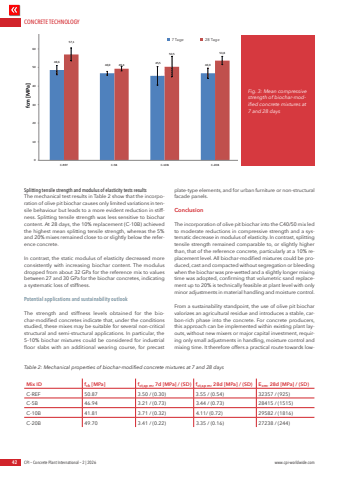
CONCRETE TECHNOLOGY42 CPI %u2013 Concrete Plant International %u2013 2 | 2026 www.cpi-worldwide.comSplitting tensile strength and modulus of elasticity tests resultsThe mechanical test results in Table 2 show that the incorporation of olive pit biochar causes only limited variations in tensile behaviour but leads to a more evident reduction in stiffness. Splitting tensile strength was less sensitive to biochar content. At 28 days, the 10% replacement (C-10B) achieved the highest mean splitting tensile strength, whereas the 5% and 20% mixes remained close to or slightly below the reference concrete. In contrast, the static modulus of elasticity decreased more consistently with increasing biochar content. The modulus dropped from about 32 GPa for the reference mix to values between 27 and 30 GPa for the biochar concretes, indicating a systematic loss of stiffness. Potential applications and sustainability outlookThe strength and stiffness levels obtained for the biochar-modified concretes indicate that, under the conditions studied, these mixes may be suitable for several non-critical structural and semi-structural applications. In particular, the 5%u201310% biochar mixtures could be considered for industrial floor slabs with an additional wearing course, for precast plate-type elements, and for urban furniture or non-structural facade panels.ConclusionThe incorporation of olive pit biochar into the C40/50 mix led to moderate reductions in compressive strength and a systematic decrease in modulus of elasticity. In contrast, splitting tensile strength remained comparable to, or slightly higher than, that of the reference concrete, particularly at a 10% replacement level. All biochar-modified mixtures could be produced, cast and compacted without segregation or bleeding when the biochar was pre-wetted and a slightly longer mixing time was adopted, confirming that volumetric sand replacement up to 20% is technically feasible at plant level with only minor adjustments in material handling and moisture control.From a sustainability standpoint, the use of olive pit biochar valorizes an agricultural residue and introduces a stable, carbon-rich phase into the concrete. For concrete producers, this approach can be implemented within existing plant layouts, without new mixers or major capital investment, requiring only small adjustments in handling, moisture control and mixing time. It therefore offers a practical route towards low48,6 46,9 45,5 46,957,149,450,5 53,8010203040506070C-REF C-5B C-10B C-20Bfcm [MPa]7 days 28 daysFig. 3: Mean compressive strength of biochar-modified concrete mixtures at 7 and 28 days7 Tage 28 TageTable 2: Mechanical properties of biochar-modified concrete mixtures at 7 and 28 daysMix ID fck [MPa] fct,sp m, 7d [MPa] / (SD) fct,sp m, 28d [MPa] / (SD) Ecm, 28d [MPa] / (SD)C-REF 50.87 3.50 / (0.30) 3.55 / (0.54) 32357 / (925)C-5B 46.94 3.21 / (0.73) 3.44 / (0.73) 28415 / (1515)C-10B 41.81 3.71 / (0.32) 4.11/ (0.72) 29582 / (1816)C-20B 49.70 3.41 / (0.22) 3.35 / (0.16) 27238 / (244)


