


Page 40 - Demo
P. 40
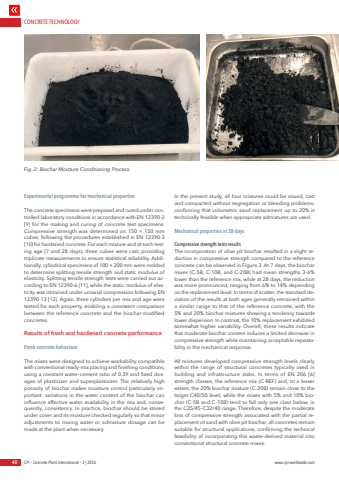
CONCRETE TECHNOLOGY40 CPI %u2013 Concrete Plant International %u2013 2 | 2026 www.cpi-worldwide.comExperimental programme for mechanical propertiesThe concrete specimens were prepared and cured under controlled laboratory conditions in accordance with EN 12390-2 [9] for the making and curing of concrete test specimens. Compressive strength was determined on 150 %u00d7 150 mm cubes, following the procedures established in EN 12390-3 [10] for hardened concrete. For each mixture and at each testing age (7 and 28 days), three cubes were cast, providing triplicate measurements to ensure statistical reliability. Additionally, cylindrical specimens of 100 %u00d7 200 mm were molded to determine splitting tensile strength and static modulus of elasticity. Splitting tensile strength tests were carried out according to EN 12390-6 [11], while the static modulus of elasticity was obtained under uniaxial compression following EN 12390-13 [12]. Again, three cylinders per mix and age were tested for each property, enabling a consistent comparison between the reference concrete and the biochar-modified concretes.Results of fresh and hardened concrete performanceFresh concrete behaviourThe mixes were designed to achieve workability compatible with conventional ready-mix placing and finishing conditions, using a constant water%u2013cement ratio of 0.39 and fixed dosages of plasticizer and superplasticizer. The relatively high porosity of biochar makes moisture control particularly important: variations in the water content of the biochar can influence effective water availability in the mix and, consequently, consistency. In practice, biochar should be stored under cover and its moisture checked regularly so that minor adjustments to mixing water or admixture dosage can be made at the plant when necessary.In the present study, all four mixtures could be mixed, cast and compacted without segregation or bleeding problems, confirming that volumetric sand replacement up to 20% is technically feasible when appropriate admixtures are used.Mechanical properties at 28 daysCompressive strength tests resultsThe incorporation of olive pit biochar resulted in a slight reduction in compressive strength compared to the reference concrete can be observed in Figure 3. At 7 days, the biochar mixes (C-5B, C-10B, and C-20B) had mean strengths 3%u20136% lower than the reference mix, while at 28 days, the reduction was more pronounced, ranging from 6% to 14% depending on the replacement level. In terms of scatter, the standard deviation of the results at both ages generally remained within a similar range to that of the reference concrete, with the 5% and 20% biochar mixtures showing a tendency towards lower dispersion. In contrast, the 10% replacement exhibited somewhat higher variability. Overall, these results indicate that moderate biochar content induces a limited decrease in compressive strength while maintaining acceptable repeatability in the mechanical response.All mixtures developed compressive strength levels clearly within the range of structural concretes typically used in building and infrastructure slabs. In terms of EN 206 [6]strength classes, the reference mix (C-REF) and, to a lesser extent, the 20% biochar mixture (C-20B) remain close to the target C40/50 level, while the mixes with 5% and 10% biochar (C-5B and C-10B) tend to fall only one class below, in the C35/45%u2013C32/40 range. Therefore, despite the moderate loss of compressive strength associated with the partial replacement of sand with olive pit biochar, all concretes remain suitable for structural applications, confirming the technical feasibility of incorporating this waste-derived material into conventional structural concrete mixes.Fig. 2: Biochar Moisture Conditioning Process.


