


Page 27 - Demo
P. 27
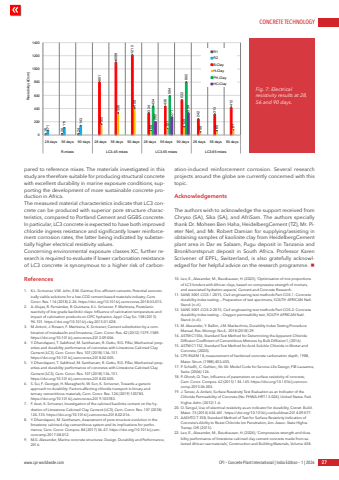
CONCRETE TECHNOLOGYwww.cpi-worldwide.com CPI %u2013 Concrete Plant International | India Edition %u2013 1 | 2026 27162024711111438011099121233443653224231341216533640869101 125496581434594802202271334020040060080010001200140028 days 56 days 90 days 28 days 56 days 90 days 28 days 56 days 90 days 28 days 56 days 90 daysR-mixes LC3-45 mixes LC3-55 mixes LC3-65 mixesResistivity (k%u03a9cm)R1R2B-ClayH-ClayPH-ClayHC-ClayFig. 7: Electrical resistivity results at 28, 56 and 90 days. pared to reference mixes. The materials investigated in this study are therefore suitable for producing structural concrete with excellent durability in marine exposure conditions, supporting the development of more sustainable concrete production in Africa. The measured material characteristics indicate that LC3 concrete can be produced with superior pore structure characteristics, compared to Portland Cement and GGBS concrete. In particular, LC3 concrete is expected to have both improved chloride ingress resistance and significantly lower reinforcement corrosion rates, the latter being indicated by substantially higher electrical resistivity values. Concerning environmental exposure classes XC, further research is required to evaluate if lower carbonation resistance of LC3 concrete is synonymous to a higher risk of carbonation-induced reinforcement corrosion. Several research projects around the globe are currently concerned with this topic. Acknowledgements The authors wish to acknowledge the support received from Chryso (SA), Sika (SA), and AfriSam. The authors specially thank Dr. Mohsen Ben Haha, HeidelbergCement (TZ), Mr. Pieter Nel, and Mr. Robert Damian for supplying/assisting in obtaining samples of kaolinite clay from HeidelbergCement plant area in Dar es Salaam, Pugu deposit in Tanzania and Bronkhorstspruit deposit in South Africa. Professor Karen Scrivener of EPFL, Switzerland, is also gratefully acknowledged for her helpful advice on the research programme. nReferences1. K.L. Scrivener, V.M. John, E.M. Gartner, Eco-efficient cements: Potential economically viable solutions for a low-CO2 cement-based materials industry, Cem. Concr. Res. 114 (2018) 2%u201326. https://doi.org/10.1016/j.cemconres.2018.03.015.2. A. Alujas, R. Fern%u00e1ndez, R. Quintana, K.L. Scrivener, F. Martirena, Pozzolanic reactivity of low grade kaolinitic clays: Influence of calcination temperature and impact of calcination products on OPC hydration, Appl. Clay Sci. 108 (2015) 94%u2013101. https://doi.org/10.1016/j.clay.2015.01.028.3. M. Antoni, J. Rossen, F. Martirena, K. Scrivener, Cement substitution by a combination of metakaolin and limestone, Cem. Concr. Res. 42 (2012) 1579%u20131589. https://doi.org/10.1016/j.cemconres.2012.09.006.4. Y. Dhandapani, T. Sakthivel, M. Santhanam, R. Gettu, R.G. Pillai, Mechanical properties and durability performance of concretes with Limestone Calcined Clay Cement (LC3), Cem. Concr. Res. 107 (2018) 136%u2013151. https://doi.org/10.1016/j.cemconres.2018.02.005. 5. Y. Dhandapani, T. Sakthivel, M. Santhanam, R. Gettu, R.G. Pillai, Mechanical properties and durability performance of concretes with Limestone Calcined Clay Cement (LC3), Cem. Concr. Res. 107 (2018) 136%u2013151. https://doi.org/10.1016/j.cemconres.2018.02.005.6. S. Sui, F. Georget, H. Maraghechi, W. Sun, K. Scrivener, Towards a generic approach to durability: Factors affecting chloride transport in binary and ternary cementitious materials, Cem. Concr. Res. 124 (2019) 105783. https://doi.org/10.1016/j.cemconres.2019.105783.7. F. Avet, K. Scrivener, Investigation of the calcined kaolinite content on the hydration of Limestone Calcined Clay Cement (LC3), Cem. Concr. Res. 107 (2018) 124%u2013135. https://doi.org/10.1016/j.cemconres.2018.02.016.8. Y. Dhandapani, M. Santhanam, Assessment of pore structure evolution in the limestone calcined clay cementitious system and its implications for performance, Cem. Concr. Compos. 84 (2017) 36%u201347. https://doi.org/10.1016/j.cemconcomp.2017.08.012.9. M.G. Alexander, Marine concrete structures: Design, Durability and Performance, 2016.10. Leo, E., Alexander, M., Beushausen, H. (2023), %u2018Optimisation of mix proportions of LC3 binders with African clays, based on compressive strength of mortars, and associated hydration aspects%u2019, Cement and Concrete Research.11. SANS 3001-CO3-1:2015, Civil engineering test methods Part CO3-1: Concrete durability index testing %u2014 Preparation of test specimens, SOUTH AFRICAN Natl. Stand. (n.d.).12. SANS 3001-CO3-2:2015, Civil engineering test methods Part CO3-2: Concrete durability index testing %u2014 Oxygen permeability test, SOUTH AFRICAN Natl. Stand. (n.d.).13. M. Alexander, Y. Ballim, J.M. Mackechnie, Durability Index Testing Procedure Manual, Res. Monogr. No.4,. 2018 (2018) 29.14. ASTM C1556, Standard Test Method for Determining the Apparent Chloride Diffusion Coefficient of Cementitious Mixtures by Bulk Diffusion1, (2016).15. ASTM C1152, Standard Test Method for Acid-Soluble Chloride in Mortar and Concrete, (2020).16. CPS RILEM 18, measurement of hardened concrete carbonation depth, 1988, Mater. Struct. (1988) 453%u2013455.17. P. Schie%u00dfl;, C. Gehlen;, fib 34: Model Code for Service-Life Design, FIB Lausanne, Switz. (2006) 126.18. P. Ghosh, Q. Tran, Influence of parameters on surface resistivity of concrete, Cem. Concr. Compos. 62 (2015) 134%u2013145. https://doi.org/10.1016/j.cemconcomp.2015.06.003.19. J. Tanesi, A. Ardani, Surface Resistivity Test Evaluation as an Indicator of the Chloride Permeability of Concrete (No. FHWA-HRT-13-024), United States. Fed. Highw. Adm. (2012) 1%u20136.20. O. Sengul, Use of electrical resistivity as an indicator for durability, Constr. Build. Mater. 73 (2014) 434%u2013441. https://doi.org/10.1016/j.conbuildmat.2014.09.077.21. AASHTO T 358, Standard Method of Test for Surface Resistivity Indication of Concrete%u2019s Ability to Resist Chloride Ion Penetration, Am. Assoc. State Highw. Transp. Off. (2015).22. Leo, E., Alexander, M., Beushausen, H. (2024), %u2018Compressive strength and durability performance of limestone calcined clay cement concrete made from selected African raw materials%u2019, Construction and Building Materials, Volume 438.


