


Page 18 - Demo
P. 18
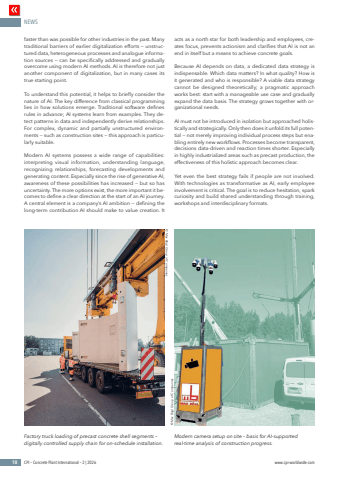
NEWS18 CPI %u2013 Concrete Plant International %u2013 2 | 2026 www.cpi-worldwide.comfaster than was possible for other industries in the past. Many traditional barriers of earlier digitalization efforts %u2014 unstructured data, heterogeneous processes and analogue information sources %u2014 can be specifically addressed and gradually overcome using modern AI methods. AI is therefore not just another component of digitalization, but in many cases its true starting point.To understand this potential, it helps to briefly consider the nature of AI. The key difference from classical programming lies in how solutions emerge. Traditional software defines rules in advance; AI systems learn from examples. They detect patterns in data and independently derive relationships. For complex, dynamic and partially unstructured environments %u2014 such as construction sites %u2014 this approach is particularly suitable.Modern AI systems possess a wide range of capabilities: interpreting visual information, understanding language, recognizing relationships, forecasting developments and generating content. Especially since the rise of generative AI, awareness of these possibilities has increased %u2014 but so has uncertainty. The more options exist, the more important it becomes to define a clear direction at the start of an AI journey.A central element is a company%u2019s AI ambition %u2014 defining the long-term contribution AI should make to value creation. It acts as a north star for both leadership and employees, creates focus, prevents actionism and clarifies that AI is not an end in itself but a means to achieve concrete goals.Because AI depends on data, a dedicated data strategy is indispensable. Which data matters? In what quality? How is it generated and who is responsible? A viable data strategy cannot be designed theoretically; a pragmatic approach works best: start with a manageable use case and gradually expand the data basis. The strategy grows together with organizational needs.AI must not be introduced in isolation but approached holistically and strategically. Only then does it unfold its full potential %u2014 not merely improving individual process steps but enabling entirely new workflows. Processes become transparent, decisions data-driven and reaction times shorter. Especially in highly industrialized areas such as precast production, the effectiveness of this holistic approach becomes clear.Yet even the best strategy fails if people are not involved. With technologies as transformative as AI, early employee involvement is critical. The goal is to reduce hesitation, spark curiosity and build shared understanding through training, workshops and interdisciplinary formats.Factory truck loading of precast concrete shell segments %u2013 digitally controlled supply chain for on-schedule installation. Modern camera setup on site %u2013 basis for AI-supported real-time analysis of construction progress. %u00a9 Max B%u00f6gl Group of Companies%u00a9 Max B%u00f6gl Group of Companies


