


Page 16 - Demo
P. 16
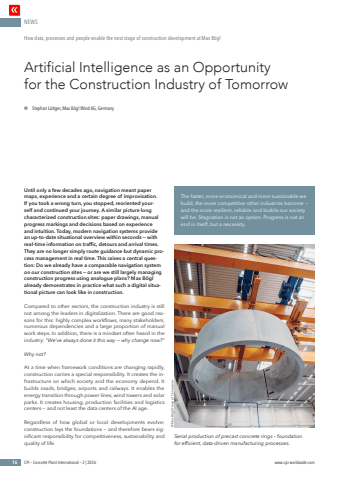
NEWS16 CPI %u2013 Concrete Plant International %u2013 2 | 2026 www.cpi-worldwide.comUntil only a few decades ago, navigation meant paper maps, experience and a certain degree of improvisation. If you took a wrong turn, you stopped, reoriented yourself and continued your journey. A similar picture long characterized construction sites: paper drawings, manual progress markings and decisions based on experience and intuition. Today, modern navigation systems provide an up-to-date situational overview within seconds %u2014 with real-time information on traffic, detours and arrival times. They are no longer simply route guidance but dynamic process management in real time. This raises a central question: Do we already have a comparable navigation system on our construction sites %u2014 or are we still largely managing construction progress using analogue plans? Max B%u00f6gl already demonstrates in practice what such a digital situational picture can look like in construction.Compared to other sectors, the construction industry is still not among the leaders in digitalization. There are good reasons for this: highly complex workflows, many stakeholders, numerous dependencies and a large proportion of manual work steps. In addition, there is a mindset often heard in the industry: %u201cWe%u2019ve always done it this way %u2014 why change now?%u201dWhy not?At a time when framework conditions are changing rapidly, construction carries a special responsibility. It creates the infrastructure on which society and the economy depend. It builds roads, bridges, airports and railways. It enables the energy transition through power lines, wind towers and solar parks. It creates housing, production facilities and logistics centers %u2014 and not least the data centers of the AI age.Regardless of how global or local developments evolve: construction lays the foundations %u2014 and therefore bears significant responsibility for competitiveness, sustainability and quality of life.The faster, more economical and more sustainable we build, the more competitive other industries become %u2014 and the more resilient, reliable and livable our society will be. Stagnation is not an option. Progress is not an end in itself, but a necessity.Artificial Intelligence as an Opportunity for the Construction Industry of TomorrowHow data, processes and people enable the next stage of construction development at Max B%u00f6gln Stephan L%u00fcttger, Max B%u00f6gl Wind AG, GermanySerial production of precast concrete rings %u2013 foundation for efficient, data-driven manufacturing processes. %u00a9 Max B%u00f6gl Group of Companies


